Opinion polls
- According to a 2019 Gallup survey, 40% of Americans believe that God created man in his present form (2000: 47%), 33% believe that God guided him to his present form (2000: 40%), and 22% believe that God was irrelevant to the question (2000: 9%).
- In a MORI poll asking Britons in 2006 what best described their view of the origin and development of life, 22% chose creationism, 17% intelligent design and 48% evolution theory.
- In an Opinionpanel Research poll asking the same question of university students, 14% expressed support for ‘creationism’, 22% for ‘intelligent design’ and 56% for ‘evolution theory’.
- There is no creationist ‘movement’ in the UK. Rather (according to a report commissioned by Theos), creationists encompass a wide spectrum of scientific beliefs. Creationism there is primarily a theological position.
- In a poll by Survata 37% of the 5,886 Americans surveyed said they believed in the existence of extraterrestrial life, 21% said they did not and 42% were unsure. Responses varied by religion: 55% of atheists said they believed, as against 44% of Muslims and 32% of Christians. Evidence of extraterrestrial life has yet to be found.
- Among members of the National Academy of Sciences USA, in 1914 28% believed in a personal God, in 1933 15%, in 1998 7% (Larson & Witham 1998). In 2013, Fellows of the Royal Society (the equivalent UK body) responding to a survey affirmed strong opposition to the belief in a personal god, to the existence of a supernatural entity and to survival of death (Stirrat & Cornwell 2013).
The appearance of design in the world is ‘overwhelming’
- In The Blind Watchmaker evangelist for atheism
 Richard Dawkins defined biology as ‘the study of complicated things that give the appearance of having been designed for a purpose’ (p 1). In a newspaper interview he admitted that the appearance of design was ‘overwhelming’. It would be hard to disagree. Nonetheless, his goal is to persuade people that the appearance is illusory, by imputing the creative powers of the apparent designer (God) to agents within nature (random mutation and between-species competition). Hence his statement: ‘Evolution by natural selection produces an excellent simulacrum of design, mounting prodigious heights of complexity and elegance.’ A quasi-religious belief-statement if ever there was one.
 - To get an idea of what ‘design’ means in biology, go no further than your own body, from its saliva glands to its toe nails, from its digestive system to its ability to identify and repair any cut or bruise. The software for bringing a fertilised egg into a state of fully functioning adulthood is popularly equated with an organism’s DNA. Actually, DNA is a set of instructions for making specific proteins, but it certainly is complex. According to one recent estimate, a 16-metre-high printout of the program at a density of 1,000 base pairs per square centimetre would stretch at least 30 kilometres long. But as well as directing the manufacture of specific proteins, an organism must also direct the organisation of proteins into specific cell types, cell types into specific tissues, tissues into specific organs, and everything into a coordinated body. Most of a human being’s biological development takes place within nine months, but the program is so complex that scientists collectively working on it for billions of years still do not understand much more than the DNA part of it.
- Indeed we are still discovering things about our own anatomy. In 2018 biologists announced the discovery of a network of channels that carry fluid through the body. In 2019 they announced the discovery of a new kind of blood vessel. “It’s totally crazy there are still things to find out about human anatomy,” said Matthias Gunzer of University Duisburg-Essen.

Evolution as adaptation
- One of the ways in which the concept of design is discredited is to suggest it is inconsistent with adaptedness to a particular environment. That is not so: an organism capable of adapting to a change in environment requires more inbuilt information – more power in the genetic program – than a hypothetical organism incapable of adaptation. The world is in continual flux, and a foreknowing Creator would have had to provide for organisms to change (‘evolve’). Enabling the organism to adapt to a changing world is thus another function of DNA.
- God, as revealed in the Hebrew record, is one who sees all things from the beginning, because he is outside time. He thus has perfect foreknowledge. He also has ultimate control of his creation. History has a fore-ordained beginning, middle and end. Since nothing is impossible for him, there are no limits to what he could have packed into the genetic instructions of an organism.
- How animals adapt is far from clear. Moths and butterflies were supposed to have ‘evolved’ their
 proboscises as a way of exploiting the nectar provided by flowering plants, which appeared in the Cretaceous: opportunity knocked and, little by little, mutations assembled these exquisitely crafted tools. With the discovery that the insects predate flowering plants the explanation has had to change – illustrating the fact that explanations of this sort are just just-so stories, adapting as the facts change.
Evolution through natural selection
- The central tenet of the Darwinian account of life is that species are continually mutating. Because of competition, only those best fitted to their environment and best able to fend off competitors survive, and over time this gives rise to new body plans and to the acquisition of new organs within those body plans.
- If this is right, it has to be supported by the fossil record, which is mostly a record of marine life. The truth, however, is that ‘direct evidence of interspecific [between-species] competition is extremely rare’ (Klompmaker & Finnegan 2018). Rather, predation and physical disturbances appear to keep marine communities below carrying capacity and thereby to reduce competitive interaction.
There are at least five ‘kingdoms’ of life, not just plants and animals
- It used to be that kingdom was the highest level of biological classification, and organisms were classified into just two, plants and animals. Now the highest level is the domain, of which there are three: eukaryotes, comprising all organisms with nuclei in their cells, and two very different groups of microbe: bacteria and archaea. The eukaryotes comprise four kingdoms: plants, animals, fungi and protists (unicellular algae and protozoans).
- ‘How the eukaryotic cell came to be is one of the greatest enigmas in biology’ (Nature 446:983). This relates to the biggest of all classification gaps, between one domain and another. Evolution theory assumes that the gaps arise through former intermediate forms becoming extinct, but in the fossil record intermediates between domains, between kingdoms and between phyla – i.e. the biggest, most fundamental gaps – are lacking.
Biologists admit that it is impossible to construct a single tree of life
- Efforts to infer what kind of organism the last common ancestor might have been before it branched into different domains and kingdoms have ended in frustration, for genetic analyses do not support tree-thinking. Ignoring the possibility that belief in common descent might be misplaced, biologists try to visualise close to the beginning a thicket of gene transfers, thereby obscuring – helping to explain, if you will – the vast difference between one domain and another.
- Even if you assume that all ‘life’ (including non-conscious life, such as plants) does have a single origin, the ‘last universal common ancestor’ is now thought to have had a genome comparable to modern prokaryotes, comprising at least 2.5?million base pairs and encoding at least 2,600 proteins (Moody et al. 2024).

Darwin did not and could not test the reality of the tree pattern. Indeed, one is hard pressed to find some theory-free body of evidence that such a single universal pattern relating all life forms exists independently of our habit of thinking that it should.
W. F. Doolittle & E. Bapteste, 2007. Proceedings of the National Academy of Sciences 104:2045.
The Bible does not speak of Noah’s ‘Flood’
- The story of that disaster is in Genesis, the first book of the Bible, and there the word used is mabbul, occurring 12 times and referring exclusively to the first 40 days of the year-long inundation. Thereafter the term occurs again only once, in Psalm 29. When the Bible refers to floods, it uses other Hebrew words. Flood as a rendering of mabbul is a mistranslation.
 A better translation would be ‘deluge’. The disaster was like no other, requiring a word uniquely reserved for it. The New Testament word for the event is cataclysm, which in Greek means ‘deluge’.
- The mention in Psalm 29 is no exception. God is ‘enthroned over the cataclysm’, just as in the book of Revelation we behold a rainbow around the throne and before the throne a sea of glass, symbolising the waters of the cataclysm. The rainbow and the sea are eternal reminders that he who created all things once destroyed his creation.
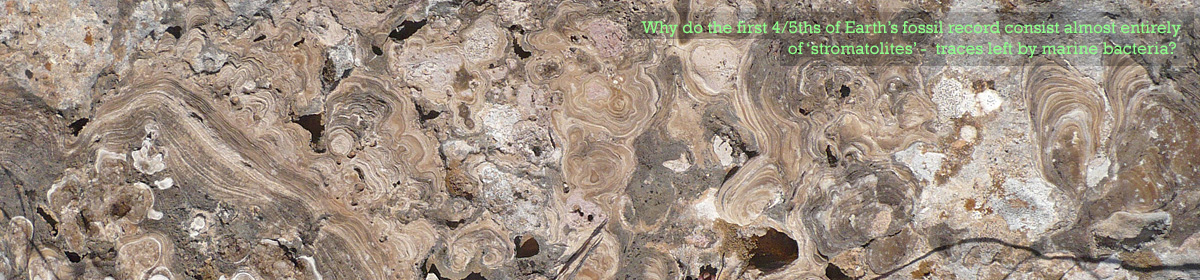
The first 80% of the fossil record consists only of microbes and algae
- The earliest signs of organic activity go back some 3.7 billion years in geological time, and all three domains are attested by 2.7 billion years ago. However, organisms more complex than microbes and plankton do not appear until 600 million years ago, with the mysterious ‘Ediacaran fauna’.
- Complex multicellular life does not appear until 550 million years ago, with the ‘Cambrian Explosion’, when organisms of astonishing diversity appear out of the blue. As Dawkins admits, ‘It is as though they were just planted there, without any evolutionary history.’ (The Blind Watchmaker, p. 229)
Genesis does not say that species were created with forms fixed for all time. On the contrary, some were created with enormous evolvability
- The first chapter of Genesis refers to ‘kinds’, not species. It does not list or define what the kinds of plants, trees, marine animals etc were, and says nothing about whether, by virtue of being kinds, their forms were fixed.
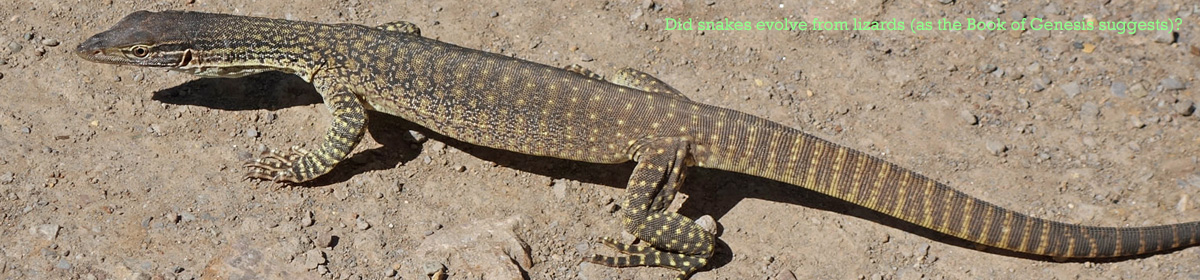
- The third chapter speaks of the ‘snake’, a kind that originally had legs. Although it was condemned to creep on its belly, we should not assume that this happened all at once.
- There is compelling scientific evidence that snakes evolved from lizards, i.e. they once did have legs. The earliest fossils of snakes show the remnants of hind legs. Lizards and snakes share the same toxin types and have a venom system that goes back to the time before some lizards lost their legs.
- The earliest fossil lizard is an iguanian from the Triassic period. The fossil record does not suggest an evolution from any non-lizard kind of animal.

What we have learned about lizards is applicable to nearly every conceptual area in modern biology, entire fields of biology had their origins in the study of lizards.
Eric Pianka and Laurie Vitt, Lizards: Windows to the Evolution of Diversity, 2003.
Nonetheless, species today are still distinct from each other
- Despite all the evolutionary diversification which has caused the number of species within a lineage to grow and grow, genetic differences between species are much greater than those within a species (Stoeckle & Thaler 2018)
- This is a mystery, since what powers diversification if species themselves are genetically so uniform?
Human genes are not 99% the same as chimpanzee genes
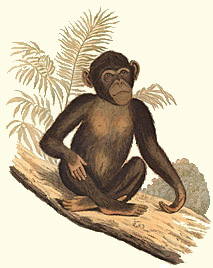 Ever since Wilson & King in 1975 said so in the journal Science, it has been asserted that, if the Y-chromosome is excluded, humans and chimpanzees are genetically 99% the same. In 2007 the same journal described that figure as a myth. ‘Human and chimpanzee gene copy numbers differ by a whopping 6.4%’, and researchers are finding that chunks of missing DNA, extra genes, different connections in gene networks and the very structure of chromosomes confound any quantification of ‘humanness’ versus ‘chimpness’. The 99% applies only to those parts of the human genome where chimps have a corresponding DNA sequence; 15% to 20% of the human genome have no clear counterparts in the chimp genome (source). In the case of the brain cortex, 17.4% of connections have been found to be specific to humans. In short, there isn’t one single way to express the genetic distance between two complicated living organisms.’
- Even if the 99% figure had been meaningful and accurate, a 1% difference would still have meant that they differed in 30 million places along their respective 3 billion pairs of nucleotides.
- The Y-chromosome determines maleness and represents about 2% of DNA. According to a study published in 2010, the Y-chromosomes of humans and chimpanzees are “horrendously different from each other”, both in sequence structure and gene content.
- It has been calculated (source) that it would take at least 1,500,000 years for just one mutation to spread through a population of 10,000 individuals. Imagine how long it would take for 30 million mutations to become fixed in the population – a ‘waiting time problem’ that affects any explanation attributing evolutionary change to chance mutations.
- According to another study, humans differ from chimpanzees partly because sequences that had been conserved up to the point they began to diverge were ‘surprisingly lost’.
- It is not thought that humans evolved from ancient chimpanzees anyway, but along a separate lineage of extinct apes that branched off from an unknown common ancestor around the same time as the African great apes (including chimpanzees) branched off.
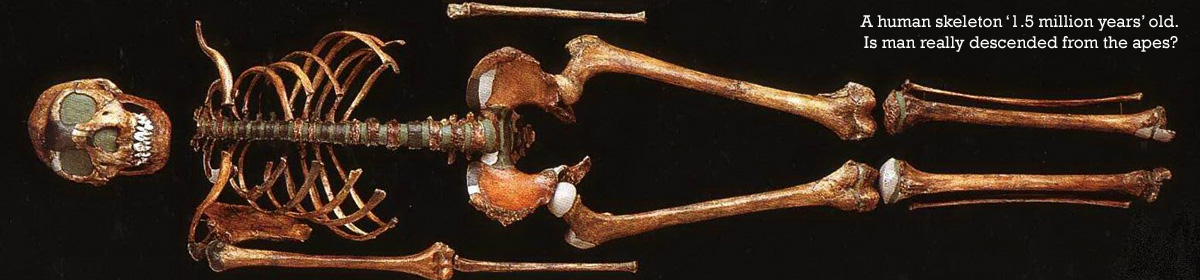
The ‘missing link’ between man and apes is still missing
- While not everyone likes the journalistic term ‘missing link’, that, with uncommon frankness, is what science writer Colin Barras was allowed to point out on the BBC’s website, a well-known organ of indoctrination.
- Evolutionary scientists are unanimous that humans evolved from a ‘last common ancestor’ (LCA) that was non-human. As the writer puts it, ‘Some researchers have a well-thought-through idea of what the LCA looked like and how it behaved. The trouble is that other researchers have equally well-reasoned models that suggest an LCA that looked and behaved in a completely different way.’

Palaeo-anthropological racism
- Ever since the fall of Nazism, the term ‘racist’ has been a term of abuse: frequently applied to ideological opponents, never applicable to oneself. Nonetheless, palaeo-anthropology – the study of fossil man – is inherently racist, for its ideological commitment to the idea that man descends from the apes via a branching series of intermediates from the apes requires that our ancestors be divided up into different species: Homo habilis, H. erectus, H. georgicus, H. heidelbergensis, H. rudolfensis and so on. Races today are a no-no, but species in the past are a yes-yes. Those who distance modern man from such forbears play on the instinctive feeling we all have that to count as one of us, an ancestor has to look like one of us, and vice versa.
- ‘Neanderthals’ were also given a separate species name: Homo neanderthalensis. They were aliens, culturally primitive compared to their Homo sapiens contemporaries – in short, not one of us. Hence it is rather shocking to find that H. sapiens has Neanderthal DNA in his own genome. “Are you telling me,” asked one member of a Royal Society audience who heard the news, “that these different species copulated with one another?” (Nature 506, 30) Since they interbred, they can’t have been different species, biologically.
- In southern Siberia ‘Neanderthals’ also shared their living space with ‘Denisovans’, yet another species, or subspecies (debate continues). They too copulated (‘hybridised’). Evidently they were not as concerned as we about racial identity. Humans inhabited the cave, we are told, for 300,000 years.
- Further down the chronological tunnel, five skulls at Dmanisi, Georgia, dated to 1.8 Ma ago, have highlighted how variable the shape of the head could be, and led some to question the idea of multiple species. According to the authors of the scientific report (Science 342, 346) the much larger than expected variability implies ‘a single evolving lineage of early Homo, with phylogeographic continuity across continents’.
- ‘Lucy’, similarly, dated to 3.5 Ma ago, is not accepted as human chiefly because she was too short – and too ancient to be one of us. Proportional to body size, her brain was only a little smaller than a modern woman’s. Palaeo-anthropologists get away with calling her an ape because there is no one to take offence.
The number of genes in a species’ genome is not a measure of its complexity
- Genes code for proteins (among other things). Since they do not explain how proteins are assembled into the complete organism, development must follow a ‘blueprint’ that resides elsewhere, but the process that remains poorly understood
- Man’s DNA comprises approximately just 20,000 genes
- Bread wheat’s DNA comprises more than 107,000 genes
- Box jellyfish differ from other jellyfish genetically more than human beings do from sea urchins
Genome size (genes + ‘non-coding’ sequences) is also not a measure of its complexity
 The largest animal genomes – ignoring dinoflagellates and amoebae – are those of fish and amphibians. That of the lungfish Protopterus aethiopicus comprises 130 billion base pairs, man’s just 3 billion. These disparities are known as the ‘c value paradox’.
- The genome of the flowering plant Paris japonica has 148 billion base pairs, more than any animal’s. The fork fern Tmesipteris oblanceolata has 160 billion base pairs.
- Dinoflagellates are a kind of microscopic, unicellular plankton. They have a cell size of 10 to 100 microns. Genome size varies from 1 to 270 billion base pairs.
- That of the single-celled Amoeba proteus is 290 billion.