
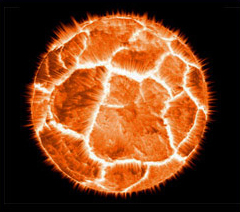
 An exploding cloud of achondrule-forming vapour could have arisen from one of two processes: rapid de-compression following shock compression as two rocky planets collided, or rapid heating of a single rocky planet from within.
Within the conventional multimillion-year timescale, the current scenario is a sea of planetesimals slugging it out in repeated impacts until a few attained the rank of planet. Out of their disintegration smaller bodies arose, which subsequently accreted to the survivors. Iron meteorites demonstrate that bodies of at least dwarf planet rank existed already by 4565 Ma. The larger the bodies were, the fewer there were and the less likely to collide. Rather like the problem of getting galaxies to collide, an unspecified something had to have disturbed them from their orbits. An impact scenario commends itself only by default, because the heat from radioactivity, while greater than now (because there was more radioactive matter and the half-lives of now extinct radioisotopes were much shorter) would not have been high enough to cause whole planets to disintegrate.
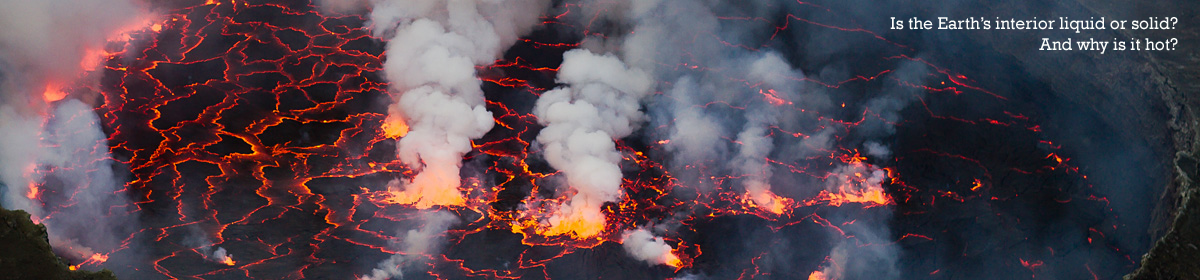
But suppose that rates of radioactivity were higher. If radioisotopes deep within a planet produced more heat than could have been conducted upward and radiated away, thermal expansion would have ruptured the outer part and magma surging through the fractures would have overwhelmed the surface. This may have been what happened. The oldest rocks of every extant terrestrial planet are igneous. Mercury, Venus and Mars were blanketed with erupted magma to a depth of several kilometers. The reason this did not happen on Earth is that the lithosphere was buffered from the melting interior by a subterranean ocean. After the Deluge, magmatism was large-scale.
Mercury is now the smallest terrestrial planet, but its disproportionately massive core – three quarters of its total mass – indicates that at some early stage it shed part of its mantle. Mercury gives us a clue as to why some planets exploded and others did not. It underwent incomplete disruption because it was intermediate in size: bigger than Earth but smaller than the planets which completely disintegrated. At that point Mercury was only partially differentiated. Most of the iron that would later have melted and sank to the centre was still in its proto-mantle and was lost when most of the mantle was lost. The remaining iron-rich stump of a body then continued to differentiate towards its present proportions, in the same way as we infer Vesta did after detaching from its parent body. And as Earth did. Earth’s present core has a mass more than seven times that of Mercury.
Here we need to delve more fundamentally into the origin of isotopes. Some were so short-lived that they could have come into being only shortly before the chondrules and CAIs in which they were trapped. One of these was the radioisotope calcium-41. We know of its existence because meteorites contain measurable amounts of its decay product, potassium-41. The half-life of a radioactive element (radioisotope) is the time taken for half of it to decay into another element, in this case just 99,400 years in present-day terms. After 10 half-lives all but 0.1% will have decayed, and if the quantity was small to begin with, the amount remaining will be immeasurable. (For comparison, uranium-238, with a current half-life of 4.47 billion years, is barely radioactive.) Thus the former presence of 41Ca in the oldest meteorites means that the radioisotope cannot have come into being much before a million years earlier. Evidently a creation origin for the 41Ca can be ruled out. Long-lived isotopes also must have had a natural origin, since whether a radioisotope is considered short-lived or long-lived is just a matter of degree.
The usual explanation for the presence of radioisotopes in the solar system is that they were synthesised in supernovas. Long-lived isotopes were injected into the nebula long before it collapsed, while the most ephemeral came from a nearby supernova that happened to occur just as the solar system was forming. In either case, the injected isotopes should have been homogeneous, a scenario the data do not support (Krestianinov et al. 2023). Alternatively, we may reason that the synthesis of unstable isotopes immediately before year zero is unlikely to have been coincidence. They were forged, not outside the solar system, but deep within the planets themselves. Some elements, such as uranium, are radioactive in all their isotopic forms, so uranium-238, by far the most stable form, probably existed from the beginning. Paradoxically, despite being very dense, it has an affinity for silicate minerals. From an initially homogeneous distribution, uranium became concentrated in the upper mantle and the granites of the middle and upper crust as the planet melted.
Thermonuclear fusion is chiefly what generates the energy of stars, including the Sun. In their cores, temperatures are high enough to overcome the electrostatic forces that keep atoms apart, and the pressure high enough to fuse the atoms into new elements. In the process, excess binding energy is converted into heat energy. The Sun being a relatively small star, the temperature at its core – around 15 million degrees – is sufficient only to fuse hydrogen. More massive stars can go further and fuse the initial product, helium, into carbon, nitrogen and oxygen. The temperature required here is around 100 million degrees.
Rates of radioactivity are related to the speed of light. The higher the speed, the faster isotopes decay, because a faster speed of light results in lower atomic mass and lower binding energy. The disintegration of atoms by decay and their synthesis by fusion are both controlled by that binding energy. If the speed of light had once been faster, the threshold above which nuclear fusion began to take place would have been lower, and the temperatures enabling the Sun now to fuse only hydrogen atoms would also have facilitated the synthesis of carbon, nitrogen and oxygen. The present Sun derives about 1% of its energy from the C-N-O cycle. Theoretically its mass is too small for such reactions. However, if carbon already existed in the core as a result of nucleosynthesis when c was higher, the element would have acted as a catalyst.
Since there is no way of directly identifying what elements lie at the centre of the Sun, we have to infer them from the elements in its atmosphere. Elements heavier than fluorine, a volatile, broadly reflect chondritic abundances, as a consequence of swallowing up the debris of exploded planets. Three elements in the atmosphere far exceed chondritic proportions (Lodders 2020): nitrogen (49 times more abundant), carbon (9.7 times) and oxygen (2.2 times) – the very elements that are the product of nuclear fusion in more massive stars, where they occur in approximately the same proportions. Thus there is evidence that significant C-N-O nucleosynthesis did occur in the past and that, since the Sun is too small to have ever reached 100 million degrees, thresholds for thermonuclear fusion were once much lower. Conceivably, heavier elements were also synthesised in processes requiring still higher energy levels, but their greater density put them beyond the power of convective currents to dredge them up. However, the Sun’s atmosphere gives no hint of nucleosynthesis beyond oxygen. Elements heavier than fluorine, a volatile, are all consistently about the same as in chondrites, strong evidence that they originated from asteroids and hence from former planets. Relative to the composition of other Sun-like stars, most heavier than oxygen are depleted (Rampalli et al. 2024).
With electrostatic forces so much lower, nucleosynthesis would also have taken place in the planets. The type of reaction would have depended on whether the planet was terrestrial or gaseous. Terrestrial planets already had the full range of stable elements, so a radioactive isotope would have been generated simply by capturing or knocking out a neutron.Aluminium, for instance, is the seventh most abundant element in planets, and turning the natural isotope 27Al into 26Al was a small step. Turning 40Ca, the eighth most abundant, into radioactive 41Ca was also a small step. Likewise with stable variants such as 18O and 17O, permutations of the more common isotope 16O. As with stars, the thresholds for nuclear reactions would have been proportional to size, i.e. to density and mass. As a consequence of the heat produced, it was the most massive rocky planets that exploded.
Chondrules and matrix are complementary in composition. The chondrules of carbonaceous chondrites have low Si/Mg and Fe/Mg ratios, the matrix high ratios, showing that the components had a common source (Palme et al. 2015). The most natural interpretation is that chondrules represent intermediate-depth material that became depleted in silicon as a result of silicon-rich minerals rising towards the surface and iron sinking towards the core. The same complementarity is seen in certain isotope ratios. For example, chondrules are enriched in tungsten-183 relative to tungsten-186 whereas the matrix is depleted. Systematic variation of this nature rules out an impact origin; it can only have been the consequence of nucleosynthesis (Budde et al. 2016), specifically within a planetary body.
Radionuclides began to be synthesised in the cores of rocky planets from the start. Heat from their decay accelerated the process faster than the rapidly falling speed of light slowed it down, until the consequent rise in pressure caused the mantle to burst. Temperatures rose most rapidly where Al and Ca and their radioactive isotopes were most abundant, in the lower mantle. At the moment of explosion, the melt vaporised and cooled into droplets. Pulverised material from the outermost layer coalesced with the droplets while vapour filled the interstices in the newly forming bodies. Shock-heated rock fragments (‘metamorphic clasts’) also entered the mix. The depressurised core broke up into bodies of dwarf-planet size.
The explosions were of course violent, but the gravity of the exploding body put a brake on the dispersing fragments. Some of the fragments remained in the vicinity, some crashed into other planets, some went into orbit around them. The retention of volatile sodium in the chondrules but not in the higher-temperature CAIs shows that they formed in an environment dense enough to prevent evaporation, denser than the supposed nebula (Alexander et al. 2008). Radiogenic heating continued for a time within the new bodies.
 The four non-rocky planets started out as pure hydrogen, like the Sun. They were massive enough to fuse helium in their interiors but not the heavier elements. Jupiter’s temperature at the core is now around 20,000° C and its composition approximately 75% hydrogen and 24% helium by mass. Saturn is less massive and cooler at its core, around 12,000° C, so fused a smaller proportion. The minor elements C, N, S, P, Ar, Kr and Xe are three times more abundant than in the Sun (Cavalié et al. 2023). Why these should be in excess is not well understood; possibly they came from volatile-rich asteroids and comets.
Uranus and Neptune are 15–18% less massive than Saturn and contain a smaller proportion of helium. Estimates of their rock content depend heavily on modelling assumptions. Whether the rock is diffuse or concentrated in the core is also unknown.
One of the great mysteries is why Jupiter, Saturn and Neptune should radiate twice as much energy as they receive from the Sun. One suggestion is that the excess heat arises from fusion of deuterium (Fukuhara 2020). However, this does not account for Neptune’s high heat flux. More probably the excess is residual heat from the no longer occurring fusion of helium. Uranus, a relatively cool planet, is the odd man out. If a large body crashed into it and caused its 98º tilt, some of its deep interior may have been exhumed so that the heat radiated away.
That chondrules originated from mantle silicates that underwent catastrophic heating is no longer controversial, whatever the cause. Chondrites do not represent the primordial material from which asteroids accreted and then differentiated, for differentiated bodies existed already before the formation of chondrules (Sokol et al. 2007). According to many researchers, ‘Chondrules and refractory inclusions are impact-melt objects’ (Sears 2005). ‘Chondrules and metal grains in the CB chondrites formed from a vapour-melt plume produced by a giant impact between planetary embryos’ (Krot et al. 2005). ‘Entire planetesimals were melted internally by the decay of 26Al, and collisions led to the splashing of their liquid contents. Cascades of molten droplets would thereby have been lofted into the nebula where they would have cooled to become chondrules.’ (Sanders & Taylor 2005) In other words, explosions are visualised. CAIs, too, may derive from planetary explosions (Sanders 2009).