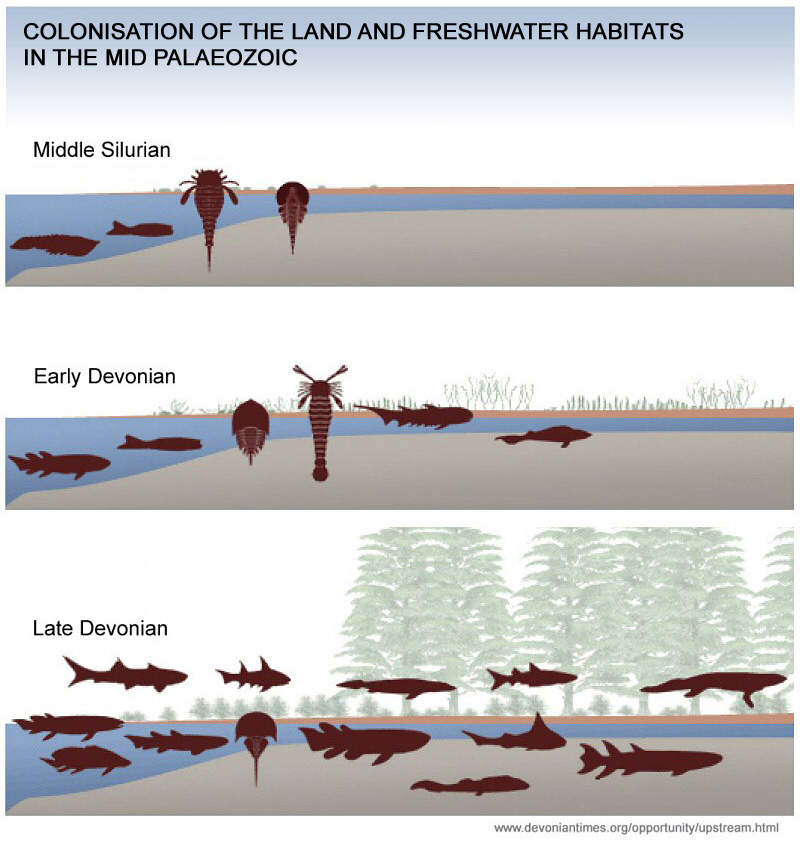
 Plants were now beginning to stabilise land surfaces. Proliferating into estuaries, river plains and deltas, they generated habitats not only for a great range of invertebrates – myriapods, insects, spiders, mites and so on – but also for freshwater fish, crustaceans and amphibians. The amphibians were tetrapods, animals with four legs, and the first tetrapods were predators, attracted to the animals that had entered these habitats before them. They appeared in places as far apart as Australia and North America, in close association with the plants, arthropods and fish that made up their natural world.
Only when there was sufficient shelter and humidity under the plant canopy and sufficient invertebrates to supply them with food is it likely that vertebrates would have begun to explore the terrestrial environment.
Jennifer A. Clack, Gaining Ground, p 96 (2002).
Environments were diversifying, and animals were diversifying in tandem, availing themselves of the opportunities: being fruitful and multiplying. The amphibious legged animals swam rather than walked, invading these brackish to freshwater coasts because their prey was invading them. Far from being pioneers, they were following where fish had gone before.
Not all fish have jaws, but those that do can be classified into two groups, those with a cartilaginous skeleton (such as sharks) and those with a bony skeleton, which ossifies from cartilage during development. Bony fish in turn group into those with ray fins and those with lobe fins. At these levels of classification, the origins of fish are obscure. Fish – which did not fossilise easily anyway – were diversifying too fast for the fossil record to keep up with the process, making the bounds of evolution impossible to define.
 The Devonian was when suddenly a huge variety of fish appeared – at least 70 families. The dominant group was the lobe-fins, from which certain tetrapods evolved. Lobe-fins still exist in the form of coelacanths and lungfish, but they are no longer dominant. ‘The age of fishes’ soon came to an end, as massive perturbations at the end of the period tore into the oceanic world, rendering 75% of fish families extinct.
With their belief in a single tree of life, palaeontologists for most of the 20th century sought to trace the ancestry of tetrapods back to lungfish. The combination of gills and lungs seemed an obvious intermediate stage. The natural world is not so simple a place, however. Air breathing has arisen independently several times in the course of fish evolution, and the view that lungfish went on to become committed land-dwellers has had to be dropped. They are now characterised as ‘living fossils’ – animals that have changed little over tens, even hundreds, of millions of years. Try as they might, they failed to climb ‘Mount Improbable’.
Today there are just three genera of lungfish, one occurring in parts of Africa, one in South America, one in Australia. They live in various habitats, such as lakes, rivers and wetlands, and their breathing apparatus varies to suit. In addition to gills for breathing under water they have highly modified swim bladders (lungs) with which to absorb oxygen gulped from the air. The most proficient air-breathers are the African lungfish. They have overcome the hazards of drought conditions not by evolving legs and by permanently returning to the water – but by developing a cardio-pulmonary system that minimises loss of oxygen and instinctively burying themselves in the mud. There, sometimes for months, they lie cocooned in a state of suspended animation, a behaviour which fossilised burrows from the early Carboniferous show to be very ancient. Australian lungfish, by contrast, live in areas that are wet all the time. They obtain most of their oxygen from the water.
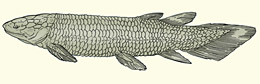 The transformation of swim-bladders into lungs, concomitant changes in heart design and blood circulation, and the ability to slow down metabolic rate to a trickle are no less remarkable innovations than the transformation of fins into legs. And they occurred remarkably quickly. Since the earliest lungfish were exclusively marine and date to the beginning of the Devonian, their specialised lungs must have arisen during the Devonian itself, not long after their first appearance. As soon as lungfish were numerous enough to impact the record, their forms were already highly distinctive. They reached their peak of diversity in the mid to late Devonian. By the Permian the number of genera had declined by over 70%, after which they ceased to innovate.
Stasis since shows that fish on the interface between sea and land are not in transition from one to the other. Despite its hazards, the intermediate zone was what they were ultimately designed for, after their marine beginnings. Their genetic make-up also tells of ‘design’. Despite representing an evolutionary dead-end, lungfish have the second largest genomes in the entire animal world, with one species, the Australian lungfish Neoceratodus forsteri, weighing in at 43 billion DNA base pairs. The largest genomes of all are those of some amoebas! Human beings have around 3 billion base pairs.
Polypterus is a genus that has true lungs. Probably the best known species is the Nile bichir. Polypterids breathe through a nostril, or spiracle, located on top of their head, and – unlike lungfish – they can use their pectoral fins to move about on land, in ungainly fashion. Unfortunately for the idea that all tetrapods evolved from lobe-fins, polypterids are ray-fins, not lobe-fins. They sit near the base of the ray-fin family-tree and date back to at least the Devonian, examples of fish with lungs and some walking ability that failed to evolve into tetrapods despite the presumed hundreds of millions of years between then and now.

Panderichthys differed from other lobe-fins in having just two pairs of fins: one at the front (the pectoral fins) and another at the back (the pelvic fins). The next closest candidate, Eusthenopteron, also had just two pairs. This arrangement, resulting from the loss of the dorsal and anal fins, is analogous to limbs in tetrapods, and the loss appears to have been abrupt. Presumably, the genetic module for them was switched off by genetic regulation.
The early tetrapods were mostly ‘rear-wheel drive’ animals with larger hind limbs than fore limbs; the fins of their presumed ancestors tended to be larger in the front than the rear. In the case of Panderichthys this difference was pronounced. The pelvic fin was ‘more primitive’ (evolutionarily earlier) than the front fin and the small pelvic girdle ‘even less tetrapod-like’ than that of Eusthenopteron (Boisvert 2005). In technical language Boisvert enumerates the ‘radical changes’ that had to take place:
The pelvic girdle became a weight-bearing structure by evolution of an ischium, a full mesio-ventral contact between the two sides of the girdle, an ilium, and a contact between the vertebral column and the girdle through a sacral rib. Fore and hind-limbs shifted laterally by reorientation of the glenoid and the acetabulum. The pectoral girdle became detached from the skull by loss of the extrascapulars, posttemporal and supracleithrum, and became adapted for limb support and muscle insertion by enlargement of the scapulo-coracoid. Lepidotrichia [rays around the fins] were lost and digits were gained. The proportions of the limb elements changed … . The postaxial processes of the ulnare and the fibula were lost, and the radius and ulna, as well as the tibia and fibula were realigned to be parallel rather than diverging. In the course of this transition, there was a shift in locomotory dominance from the forelimb to the hindlimb, which was first demonstrated by Acanthostega and Ichthyostega.
All this had to have happened in 5 million years or less (after Panderichthys and before a fragmentary tetrapod fossil called Elginerpeton). A big gap in morphology was exacerbated by a small gap in time.
Partly for this reason, Tiktaalik roseae, a fish whose discovery was announced to the world in 2006, supplanted Panderichthys in the story of how vertebrates crawled out of the water. In the paper describing the new fossil it could now be admitted that Panderichthys possessed ‘relatively few’ tetrapod-like features. Tiktaalik’s evolutionary significance is discussed elsewhere. It showed more tetrapod-like features than Panderichthys, including a few of those enumerated by Boisvert, namely partial reorientation of the pectoral glenoid and loss of the extrascapulars (but not the posttemporal or supracleithrum). However, as a result of footprint evidence predating the fossil, this animal too has had to be sidelined.
No fewer than eleven tetrapod genera are known from the Late Devonian. They are diverse from their first appearance and resist attempts to order them into a single tree (Beznosov et al. 2019). Some were mainly aquatic in lifestyle, others, as suggested by trackways in southwest Ireland, more amphibian. The best preserved are Acanthostega and Ichthyostega, from Greenland. Apart from similarities attributed to their ultimate common ancestry, the two species ‘have almost nothing in common’ (Clack, p 121). Although contemporary, they therefore cannot be closely related to each other.
 |
Ichthyostega, comprising a unique mixture of features, with massive shoulders and seven hind digits, had an amphibian life style. Acanthostega, its late Devonian contemporary, was wholly aquatic, with limbs functioning as paddles. |
Acanthostega (which means ‘spine armour’, referring to features of its skull) was entirely aquatic. A great number of fossils were found in the mass-death deposit of an ephemeral channel; what kind of water body they normally inhabited is unknown. They were all juveniles, apparently arrested in development, with bones only partially ossified. The gill skeleton was fish-like and closely resembled that of the Australian lungfish. The limb joints were not weight-bearing, and the digits – eight of them, not five as had long been expected – were linked by webbing. The hind limbs functioned as paddles, pushing towards the rear, while the belly was armoured with gastralia (bones like those on the underside of a crocodile). All in all, the animal was a mosaic of primitive and derived features, prompting some authorities to suggest that its lineage represented a reversion back to the water from a more terrestrial ancestry!
Ichthyostega, stocky and heavily built, was ‘a very strange animal, and parts of it are like no other known tetrapod or fish’ (Clack, p 115). Among its many unique features were a narrow braincase, massive shoulders, and broad, overlapping ribs. The ribcage may have had some role in breathing, and in storing air during long periods under water.
Unusually for a tetrapod, the hindlimbs were diminutive compared with the forelimbs. The hindlimbs were paddle-like, as with Acanthostega, and ended in seven digits, two more than the world had been told about before 1990 and one less than Acanthostega had. Its shoulder and hip joint mobility were restricted, and its pelvis could not have been lifted free of the ground (Pierce et al. 2012). If it moved on land at all, Ichthyostega moved like a seal, arching its back, advancing both forelimbs, and finally bringing up the rest of its body. This would have been quite unlike the sinuous, side-to-side motion of fishes swimming in water. Its forelimb musculature enabled it to raise its head above water. Other aspects of its anatomy – its fish-like tail, paddle-like hindlimbs, deeply grooved gill bars, highly specialised ear for hearing underwater, and lateral line system (a network of nerves that detects disturbances in the water, common to all fishes, because all fishes need it) – point to a predominantly aquatic existence. Its sharp teeth suggest a diet of fish and invertebrates.
Both animals should be understood in the context of a palaeogeographic setting that was mid-continental (Astin et al. 2010). Silt brought down by a vast system of braided rivers collected slowly enough for soils to form, but every so often the rivers went into spate and flooded the area. As the waters dried up, pools and billabongs dotted the floodplain, allowing the area to be colonised by fish, tetrapods and vegetation. Both animals were fossilised as a result of being washed down and buried in a flash flood. The presence of other fish, including lobe-fins, suggests that originally the tetrapods must have colonised the area from the sea, following their prey. The chemistry of the bones indicates that marine influence remained considerable. One has to imagine vast low-lying areas being periodically flooded in response to sea-level fluctuations, at the same time as sediment was washed down from the highlands.
Owing to its specialisations Ichthyostega is considered to be a side-branch of the tetrapod family tree rather than a direct ancestor; it was a short-lived evolutionary ‘experiment’, a ‘dead-end’. The tetrapods that led to the reptiles known from the Carboniferous must therefore have predated Ichthyostega and remain to be discovered. Panderichthys and Acanthostega are also thought to represent side-branches. Regardless of whether amphibian tetrapods evolved from certain species of lobe-finned fish, there is absolutely no fossil evidence that terrestrial reptiles evolved from amphibian tetrapods.
The story of tetrapod evolution has changed radically in recent years. The possession of lobe fins, it turns out, had nothing to do with being adapted for life in the shallows. Some lobe-finned fish lived in deep water, as do coelacanths today. Some ray-finned fish today have fleshy lobe-like fins which they use for walking along the sea bottom. The diversity of  modern fishes and ancient tetrapods seems purposely to subvert any attempt to construct a story where limbs and digits are acquired in the course of ‘conquering the land’. Gone is the picture of fish crawling on their fleshy fins out of ponds that had dried out under the tropical sun, in search of deeper ponds, and discovering that they could survive without them. (In reality, fish stranded in desiccated pools would simply die.) Limbs and digits were acquired while the animals concerned were still adapted for life in the water. Acanthostega, to judge from its anatomy, had no thoughts of venturing onto the land. If Ichthyostega did, it moved like a seal, not a reptile.
The characteristics which the Devonian tetrapods had in common with certain lobe-finned fish, such as flattened skulls and dorsally placed eyes, were those concordant with a similar kind of life. The tetrapods were predators lurking in the shallows, fringed here and there with vegetation. While Ichthyostega resembled a seal in some respects, other tetrapods had limbs arranged more like a crocodile’s or newt’s, with the shoulders facing sideways and arms projecting out at right angles. Just as crocodiles or newts now are not in evolutionary transition, so there is no reason to suppose that the Devonian tetrapods were.
No reason (ideological commitment aside) except one: the tetrapods appeared at the right time. They were preceded by lobe-finned fish and followed by four-footed, fully terrestrial reptiles. While the time gap between the most tetrapod-like fish and the first actual tetrapod is uncomfortably small, at least there is a gap.
Palaeontologists do not study body fossils in isolation; they study them in relation to their ecology. And it is a remarkable fact that, almost as soon as new environments presented themselves, there were almost always animals to exploit them, turning up apparently out of nowhere. Encouraged by the overall order of appearance – a recolonisation sequence which in some respects mimics the expected evolutionary sequence – palaeontologists interpret the phenomenon as animals becoming adapted to these environments by natural selection, as if the existence of a new habitat of itself produced the variations on which selection could act. Life apparently originated from the sea, and evolution by natural selection, the only game in town, must have been the mechanism. The morphological gaps are interpreted as accidents of an incomplete record.

But even the argument that the fossils appear in the right order is no longer available. In 1995 Iwan Stössel reported several trackways made by tetrapods in southwest Ireland, and these, it was subsequently determined, were of the same age as Panderichthys. When several years later Jennifer Clack discussed them, she was unaware of the dating work and supposed they were significantly younger. Convinced from the body fossil evidence that tetrapods came into being midway through the Frasnian, she ventured the opinion that ‘tracks made by a terrestrial tetrapod are unlikely to be found before the late Frasnian’.
 That the tracks were those of a tetrapod was evident from the smaller size of the front foot compared to the hind foot, and from the way the angle of stride varied as the animal moved. The maximum size of the tetrapods was one metre. Two of the trackways included sinuous drag marks left by its belly. Whether it could walk clear of the ground without the support of water is unknown, since, like crocodiles, which sometimes crawl on their bellies, it may have been capable of more than one type of gait. The environment was unvegetated sandy river channels some distance from the sea.
In 2010 similar tracks were reported from the Holy Cross Mountains in Poland. These were even earlier, dating to the Eifelian stage of the Devonian. The three imprinted levels occupied an interval of 1.5 m (probably not long in duration), and bore desiccation cracks and raindrop impressions, indicating along with other evidence an ephemeral lake within a coastal plain (Qvarnström 2018). Low vegetation grew around the water’s edge. There were several track-makers, varying in size. As at the Irish locality ephemeral lake within a coastal plain (Qvarnström 2018). Low vegetation grew around the water’s edge. There were several track-makers, varying in size. As at the Irish locality, one track showed ‘lateral sequence walking’. Most individual prints had a width of 15 cm, more than twice the size of Ichthyostega’s, consistent with an animal about 2.5 m in length. The largest was 26 cm. There were no drag marks and no signs that the feet were webbed.
Once one has stripped away the Darwinian language, the story actually told by the fossils is that of a world going through stages of ecological recovery. From a distance, recolonisation can appear like evolution, because the organisms concerned appear progressively, and in the process they diversify into new species. Exploiting the waters of the coastal margins, the Devonian tetrapods were an ecological as much as an evolutionary step up – rare in the fossil record because they were rare, at this stage, in fact.
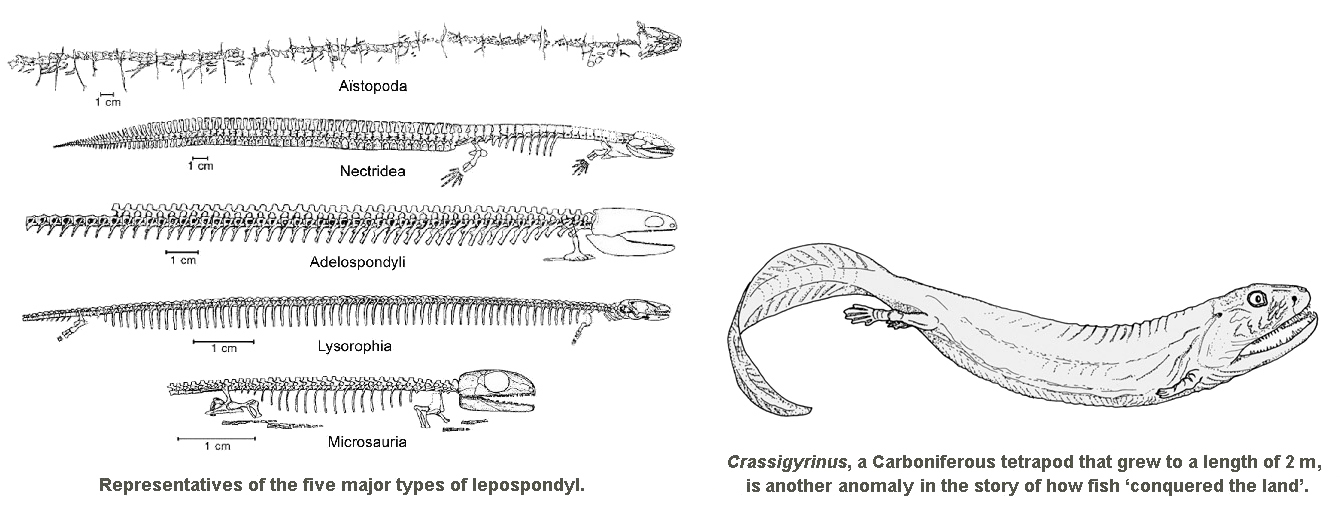 Almost immediately after the appearance of the first aquatic tetrapods, a host of other highly evolved tetrapods moved in to make the evolutionary picture even more challenging. One example is the lepospondyls (click on diagram), quite small animals that are ‘highly derived when they first appear in the fossil record, with no plausible intermediates between them and any other groups’ (Carroll 2001). While sharing some features, they are, like Tiktaalik, Acanthostega and Icthyostega, also a disparate group in relation to each other. Perhaps most anomalous are the snake-like aïstopods, which appeared in the early Carboniferous and had neither limbs nor limb girdles. On the evidence of the skull, vertebrae and ribs, they are classified as tetrapods, so are presumed to have completely lost their limbs after only just acquiring them. Even supposing that this did happen, it is difficult to see how it could have happened in the interval between the the first lepospondyl some time after the late-Devonian tetrapods and the first aïstopod in the Visean. The aïstopods may have been aquatic. The early-Carboniferous tetrapod Crassigyrinus certainly was, and is believed to have somehow retraced the evolutionary journey of its terrestrial ancestors back to the sea. Bizarre indeed!
In the light of such facts, one palaeontologist (Ahlberg 2018) has raised the question whether the aquatic lifestyle of Acanthostega might not also be a reversal from that of a ‘more terrestrially adapted ancestor’ – an ancestor, for example, such as the tetrapods that made the Middle Devonian tracks. After all, flexed elbows and laterally oriented appendages (hindlimbs sticking out from the body rather than fins aligned with it) would have made swimming more difficult, so how could they have given fish an evolutionary advantage? Why would fish have evolved a sacrum, when this weight-supporting structure was not needed for underwater propulsion? Palaeontologists accept that the lepospondyls were only ‘secondarily aquatic’; why not also Acanthostega and, to a lesser extent, Icthyostega? ‘Secondarily aquatic’ in this context meant that they had never completely let go of the water and had abandoned the terrestrial part of their lives. Tempting though it is to regard Tiktaalik and its like as intermediate ancestors, they were ‘optimised for their own lifestyle and “not on their way” to anywhere’. They went extinct, apparently in the Frasnian. Tetrapods moved into their fluvial and deltaic habitats to take their place.
Substitute co-ordinated, pre-programmed evolution of the whole genome for chance one-letter-at-a-time mutations, and the revised scenario is almost entirely what one might suggest in a Genesis-based recolonisation scenario. The huge evolutionary changes listed above by Catherine Boisvert then become conceivable, the relative rapidity of the changes understandable, the similarities between Tiktaalik and the aquatic tetrapods explicable. The aquatic tetrapods and their fish ancestors were not on the ark. Given that they were not on the ark, the aquatic tetrapods had to have evolved from fish ancestors.
Next: Rising fast – the first trees
More on the fish-tetrapod transition: From fish to amphibian