
Britain has an extraordinarily rich and diverse geological and fossil record and has some world-class collections, now much easier to appreciate as a result of efforts to show them to best advantage in state-of-the-art displays. Here are some of the most notable.
 Named after geologist Charles Lapworth (1842-1920), this museum is part of the University of Birmingham and has a fine collection of fossils and early geological maps, some of them illustrated on its website. Among the renowned lagerstätten represented is the Wenlock Limestone of the West Midlands and Welsh Borders (from the Silurian period). The museum also houses many manuscript works of Lapworth himself, who amongst other things was a leading authority on the extinct plankton called graptolites. Because these tiny branched animals changed very rapidly over time, graptolite fossils proved to be invaluable aids in working out the depositional sequence of strata in the Southern Uplands of Scotland. Lapworth showed that between the Cambrian and Silurian periods there was a gap, which he named the Ordovician. Today that period – the last of the ten Phanerozoic periods to be named – is allocated 44 million years. While it saw a huge diversification of marine life and ended with an enigmatic glaciation (though there is room for scepticism) that iced over much of Africa, the real duration of the Ordovician is likely to have been much shorter.
 In 2016 the museum was transformed by a £2.7 million project of redevelopment. There are now three public galleries. In the main hall the ‘Evolution of Life’ gives the Darwinian interpretation of fossils. Rather more factual are the animated reconstructions that show the changing environments of the Midlands at key points in Earth history. The major rock types are also attractively displayed. Upstairs the ‘Active Earth’ gallery explains about how the constant movement of tectonic plates causes earthquakes, volcanoes, climate change and the formation of mountains. A third gallery explains about minerals.
 This spectacular monument to neo-Gothic architecture houses the university’s palaeontological and zoological collections. You could spend a day here, for this is a real museum, not a playground, and in the happiest of ways it engages people at all levels, young and old. There is plenty to touch, from fossilised dinosaur eggs to stuffed animals, and plenty to see. Many of the exhibits are as spectacular as the building.
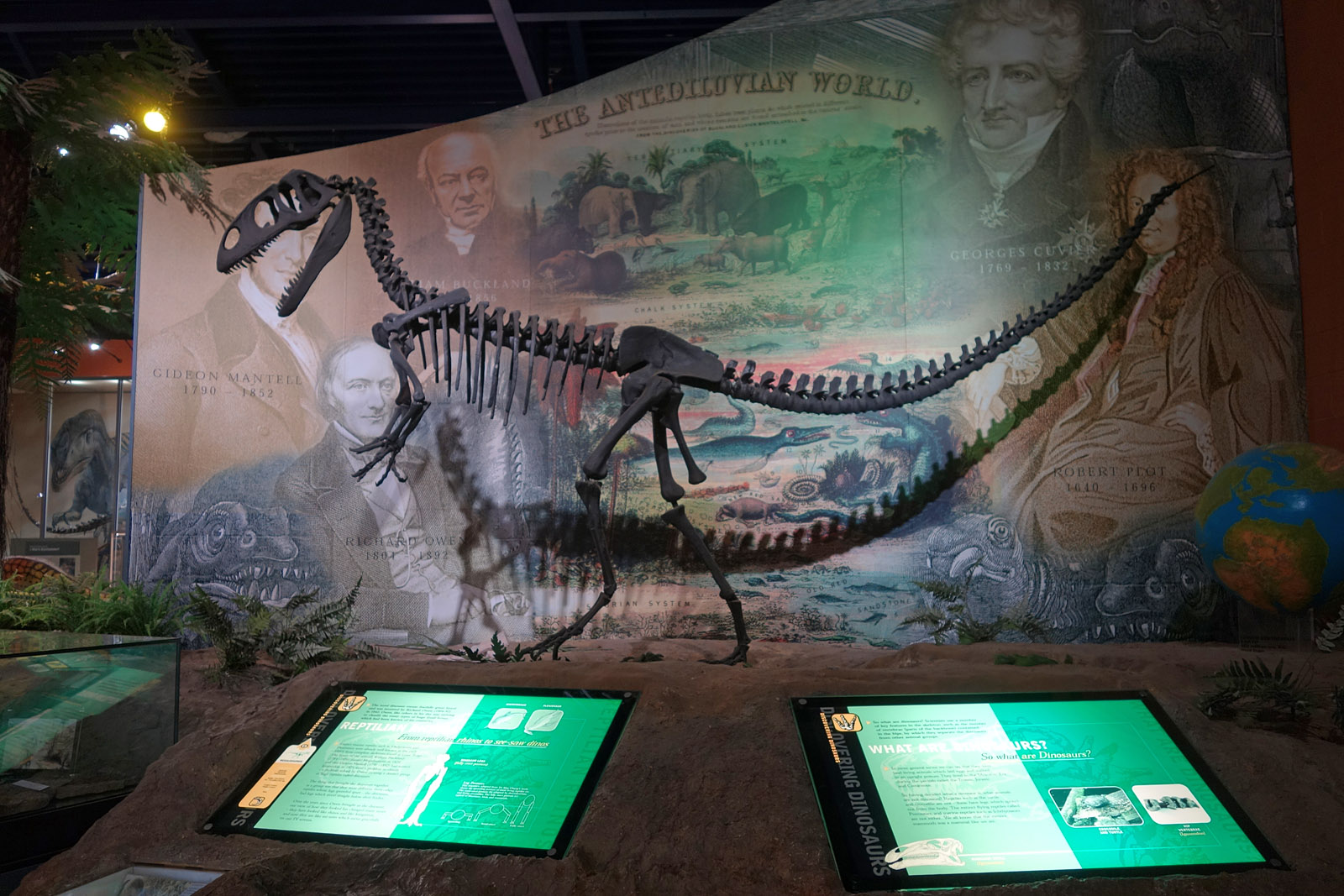
The experience starts before you enter. Sunk into the lawn are casts of dinosaur footprints from a quarry in nearby Ardley, made by Megalosaurus, the first dinosaur ever to be described (by William Buckland in 1824). Above the doorway, beside a carving of Adam and Eve and a non-Darwinian tree of life, an angel holds the ‘Book of All Nature’, reminding you of a time when science and religion were not divorced. A thicket of slender pillars greets the visitor. Before long you have a sense that the animals within the thicket are more alive than dead. A giant of an iguanadon takes centre stage, chased by an even more massive tyrannosaur, while row upon row of display cabinets introduce you to all the other vertebrate groups,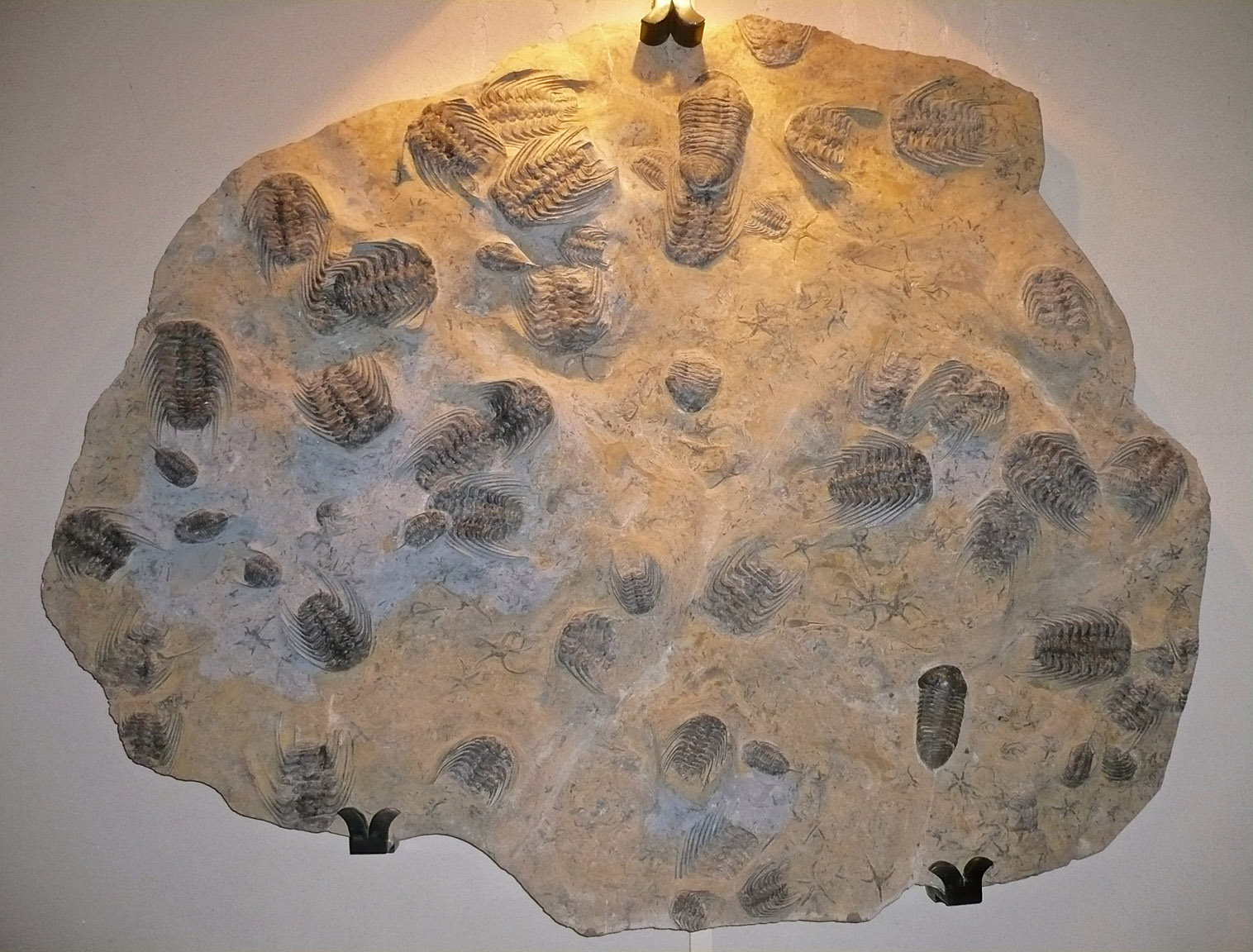 from fish to mammals. One cabinet holds the world’s most complete remains of a dodo, the inspiration for Lewis Carroll’s dodo in Alice in Wonderland. Another holds an ichthyosaur so well preserved you can see the outline of its skin around the skeleton.
The adoption of any scientific explanation, such as natural selection, is never independent of what is going on around the scientist. Social and political ideas affect the acceptance of scientific ones, as well as vice versa. It is easy to imagine scientists as seekers after absolute truth, which once found will allow society to identify and attain goals for its betterment. In practice, socio-political systems may dictate, consciously or subconsciously, what scientists are allowed to find out, and different philosophical commitments may dictate whether absolute truth is thought to be attainable or not. Scientists are people too, and their personalities affect their science and that of others.
The reader is left to consider for himself what systems of belief control or influence the scientific pursuit of truth today.
There are 1.25 million known animal species on Earth – 75% are insects. Insects are key components of every food chain – without them global ecosystems would collapse.
Perhaps that simple observation offers a profounder insight into their origin than any Darwinian suppositions. Insects exist not because they are accidents of nature but because they play a vital role in communities bigger than themselves. They appear in the fossil record suddenly, and without antecedents. Whether prey or predator, organisms are interdependent, and both their origin and subsequent diversification can be understood in the context of creation, cataclysm and ecological recovery. So take time to study and marvel at the different insect orders on display: the crickets, the termites, the praying mantids, the stick insects, the earwigs, the flies. And don’t miss the case teeming with live Madagascan hissing cockroaches up to three inches long. To repeat, there is something for everyone in this museum.
 Built in 1828, the Rotunda is the oldest geological museum in Britain, perhaps in the world. It was founded to illustrate the work of the pioneering stratigrapher William Smith (1769-1839). Smith showed that particular fossils occurred only in the strata of particular periods, allowing strata from different areas to be correlated. This ‘principle of faunal succession’ was a crucial first step in piecing together Earth’s history on a regional and ultimately global scale. In 1799 Smith produced the first ever geological map, showing the distribution of rocks around Bath. In 1815 he published the first geological map of England and Wales. His main purpose was practical, the ability to map rocks hidden from view being important for canal-building and mining. He offered no explanation as to why fossil species had such a restricted stratigraphic range.
The museum consists of three main areas. One, ‘Shell Geology Now’, shows interviews with geologists who describe what it is like to work in oil exploration, fossil preparation or researching dinosaur tracks. Also interesting is a display of the newly discovered ‘Speeton plesiosaur’ from the Lower Cretaceous. You can see signs of predation, and oysters are said to have colonised some bones. Another area on the same floor, ‘Gateway to the Dinosaur Coast,’ is a disappointment: hackneyed in its reference to dinosaurs and  only superficially child-friendly – the games may amuse, but they educate little. One redeeming feature if you bend down to knee level is a wonderful slab of fossil invertebrates. The third area is the rotunda gallery, the heart of the museum: visually stunning, and with perseverance you can make some sense of its exhibits. In presenting material on the social history of Scarborough, its natural history and even some Egyptology they try to do too much. Smith himself is crowded out. A recent addition to the museum is a display about Star Carr, described as one of the most important Early Middle Stone Age sites ever found, just a few miles south of Scarborough.
 Above the showcases is a diorama of the geology of Yorkshire’s coast as published by Smith’s nephew, John Phillips. The Jurassic sequences along this coast are of international importance. Equivalent to Lapworth’s graptolites, ammonites are the most useful fossils for determining the relative chronology of these rocks, being plentiful, of wide geographical distribution and, because of their rapid evolution, of narrow stratigraphic range. Several beautiful specimens are illustrated here. Smith’s pioneering work in establishing the sequence of zonal fossils for the British Jurassic culminated in his Stratigraphical System of Organised Fossils of 1817. He lived in Scarborough from 1824 to 1826.
 Opened in 2001, this purpose-built museum focuses on the fossil record of the Isle of Wight, encompassing the Cretaceous and later. The island has yielded up the bones of at least fifteen species of dinosaur, and inevitably the museum majors on these. However, the corridor which leads the visitor back to the time when dinosaurs were alive presents informative displays of other fossils. There’s not much that can be described as spectacular, but the entrance charges are modest, and you could spend an hour or two here.
If you do, you will find an interesting board explaining how shellfish coped with the rather muddy conditions of the chalk seafloor by evolving spines that lifted them off the seafloor or by developing broad, flat shapes that reduced their weight-to-area ratio. Another board suggests that flints derived from sponges. After burial, the silica that composed their hard parts dissolved into a gel, which then hardened into nodules. It’s a reasonable idea, though it does not explain why flints formed at such regular intervals, commonly one horizon per bed. Some flints are silicified burrows.
 In the dinosaur gallery look out for the explanation of how Hypsilophodon dinosaurs came to be fossilised. In brief, a lower bed was deposited – ‘perhaps fairly rapidly (days/weeks)’ – which then dried out and became lightly vegetated. Flash floods produced river channels and thick volumes of sand which clogged the channels and spilled onto the floodplain. Ripple marks, dinosaur footprints and water escape structures indicate that deposition was rapid and short-lived. Another flash flood surged across the floodplain, overwhelmed a herd of Hypsilophodon, and over a few ‘days or weeks’ buried them in sediment. In this way metres of sediment built up, not over tens of thousands of years, but months or, at most, a few years.
A beautiful display of fossils collected from the famous Kimmeridge Clay Formation, a slice of Jurassic time exposed on the coast of Dorset, southern England. The formation is famous for being the principal source rock for North Sea oil, but this museum will enhance its fame for another reason. If the animals were works of art when alive, so are they now as long dead exhibits, wonderfully preserved by the oxygen-poor conditions of the mud in which they were entombed, and wonderfully etched out of the rock – it is hard to resist the pun – by local palaeontologist Steve Etches, who collected them. Opened in 2017, the museum almost ranks with the likes of Germany’s Hauff Urweltmuseum and Bürgermeister-Müller Museum, also focusing on slices of the Jurassic. But the exhibition space is not large, and much of the collection remains undisplayed. Of especial note are a batch of ammonite eggs (the only example known, identical to those of modern cuttlefish), an ichthyosaur still digesting its bellyful of fish and belemnites (extinct squid-like animals), a belemnite complete with hooked tentacles and ink sac, a ventral view of the fish Caturus (illustrated right), a goose barnacle, and a lobster. Take time to listen to the videos.
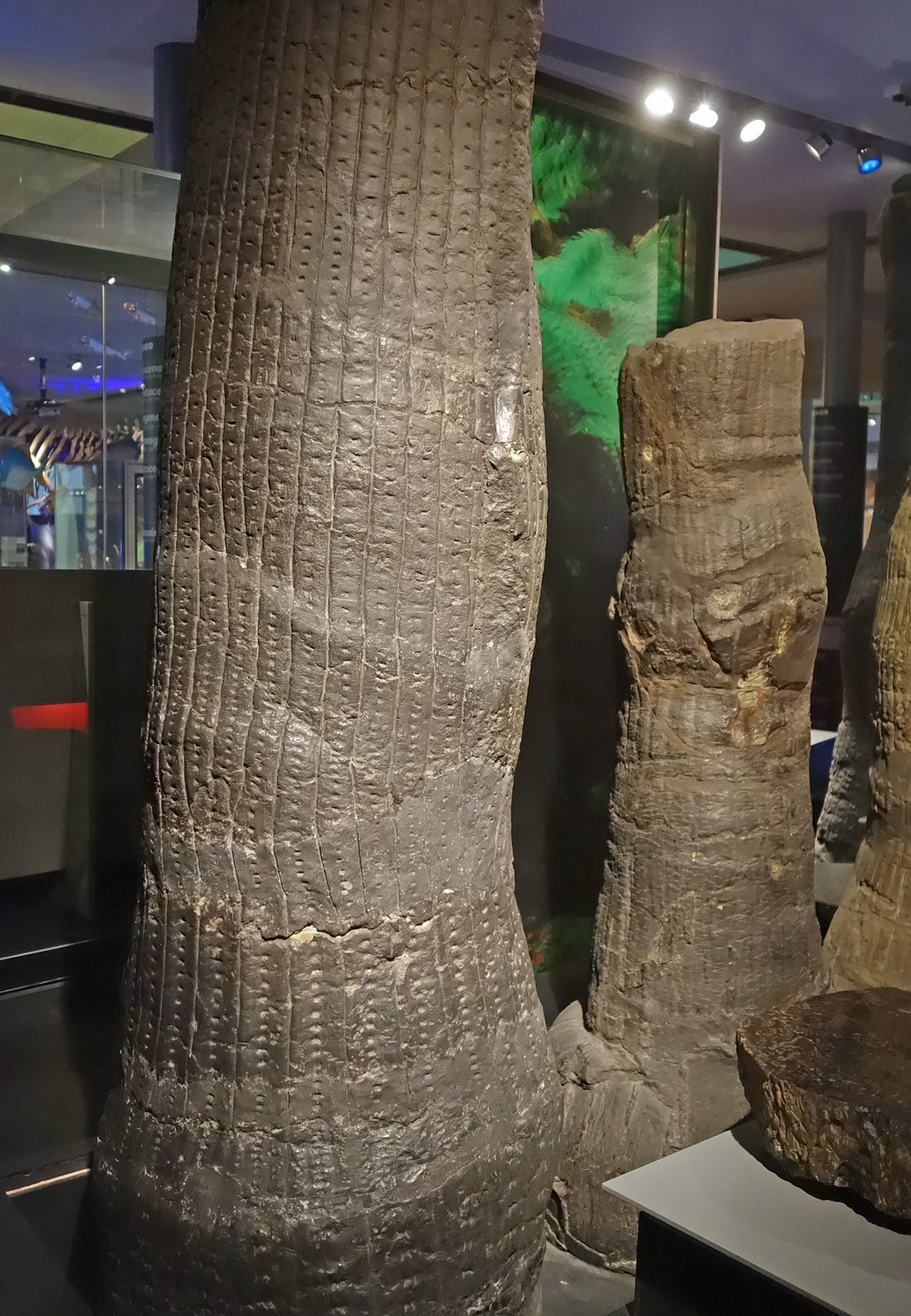 ‘Fossil stories’ is one section of a museum that also displays prehistoric and ancient Egyptian artefacts, material from Hadrians Wall, stuffed animals and other things. The fossils date from the Cretaceous back to the Carboniferous. Some of the most eye-catching are reproductions, e.g. the 4-metre high Tyrannosaurus rex and Archaeopteryx. Among the originals, the most noteworthy are casts of the trees Lepidodendron and Sigillaria, major constituents of the swamp forests that were buried by sand and eventually became the coals for which Newcastle is famous. In 2003 the surrounding North Pennines was the first part of Britain to be designated a European Geopark. Sadly, the open-cast mines and quarries which once displayed the coal seams in stratigraphic context have all been filled, though places along the coast provide limited exposures. The museum displays its exhibits in gloomy light (dimmer than implied by the photographs). Accompanying labels are pedestrian, some with typos, and trust the reader with the barest of information: ‘Fossils of Lepidodendron, bark,’ ‘These are fossils trunks of tree-like clubmosses called Sigillaria,’ ‘Slab showing many fossil ammonites, geologists refer to this as a death assemblage’ etc
 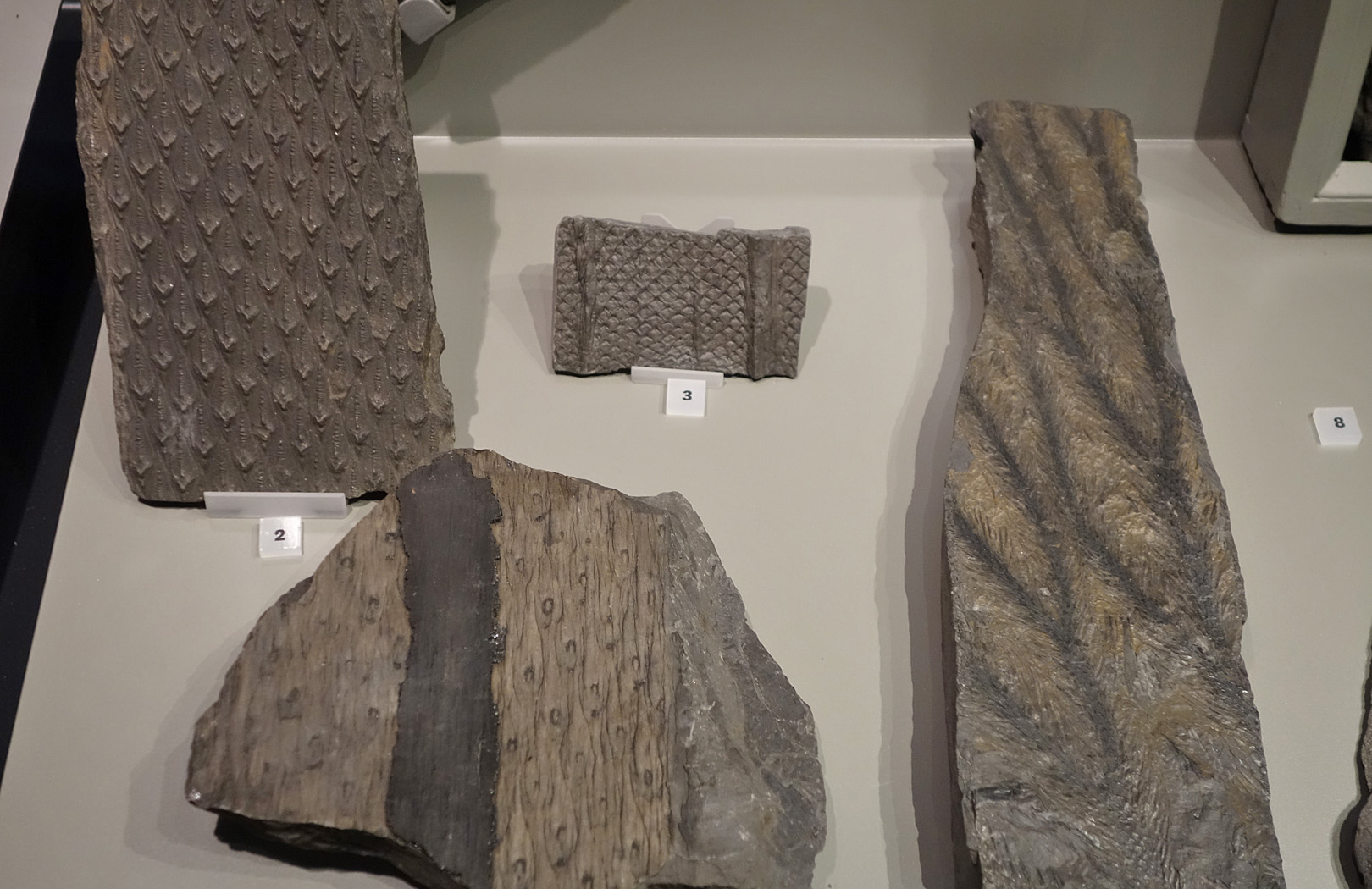 – nothing to indicate where they were found or the name of the formation, and despite the name of this part of the museum no fossil stories are told. A fine display of minerals is tagged on at the end, but again with the sparsest of information. Who is any the wiser for being told that one shiny item is ‘stibnite’, another ‘pectolite’? On the plus side, nor is there any attempt to indoctrinate visitors in the theory of evolution.