Written documents cannot have been the source for the first chapters of Genesis, since writing capable of representing grammatical speech was not invented until the 3rd millennium BC. To have had any historical basis, the Creation, the genealogies, the history of the antediluvian world, and the story of the Deluge must have passed down the generations by word of mouth. The same applies to the story about Abraham. Whether or not he was able to write, Abraham was a herdsman, not a member of the elite class of scribes and priests, and herdsmen had little use for writing. Whoever wrote Genesis must have learned about him and his descendants through family tradition. From that point – chapter 12 – the text is rich in details specific to the time and amply authenticated by archaeology (Kitchen 1995, Gordon & Rendsburg 1997).
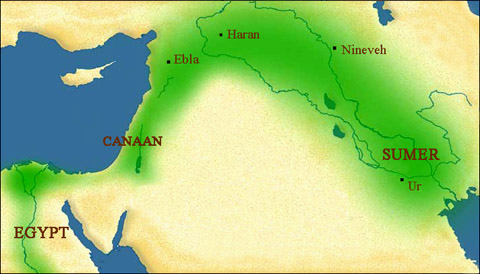
Abraham came from Sumer: lower Mesopotamia. Historians often describe Sumer as ‘the cradle of civilisation’, as if what it nursed was something innocent. In reality, the religion at its heart exercised power through the magical invocation of spirits – in other words, sorcery. Every city was ruled by a god and, much like a human king, the god dwelt in a palace in the midst of the city, manifest in his life-like statue. Close-by, a brick-built mountain with a central stairway enabled the gods of heaven to come down and the gods of the underworld to come up, so that they could meet with the resident god in council and assist in his deliberations.
 One such ziggurat stood in Ur, home-city of Abraham. Its partly restored remains constitute the most impressive monument left by the civilisation. Ur served the moon-god Nanna. It was not a place where Abraham could have learned about the monotheistic stories of early Genesis, and its idol-worship was why God told him to leave. So Abraham and his father moved to Haran, several hundred miles upstream. That city also worshipped Nanna. It seems the migrants knew too little about the god who had called them out to be confident about venturing further. After a while God spoke again: “Go to the land that I will show you.”
That land was the hill-country of Canaan, on the outskirts of Sumerian civilisation, where something close to a monotheistic cult still survived. One piece of evidence for this comes from Genesis itself. After defeating the king of Elam and his confederates, Abraham is greeted by the priest-king of Jerusalem, Melchizedek. Melchizedek means ‘The righteous one [is] king’, referring to the deity whom he served, and he blesses Abraham in the name of that deity, ‘God Most High, maker of heaven and earth.’ The word ‘God’ here is El, head of the Canaanite pantheon, to whom titles such as ‘most high’, ‘lord of heaven’, ‘maker of heaven and earth’ were regularly applied. As attested by texts from Ugarit, a city on the Syrian coast north of Canaan, El was the father of the gods.
The earth was not; you created it.
The light of the day was not; you created it;
The morning light you had not yet made.
In contrast to Sumerian kings, Ebla’s king was an elected ruler, so did not claim authority from above. He was a monotheist inasmuch as he recognised only one father deity, but a polytheist in preferentially worshipping his children, notably Hadad. The document is not therefore evidence that the tradition was pristine, only that it was less corrupted by Sumerian ideas than it later was. Whether Melchizedek worshipped other gods is not known. By this time, c. 1870 BC, few places can have resisted the new ideology that seemed to bring the numinous closer to humanity, exalted the sons of God as gods in their own right, ascribed to them powers within creation to bless and to curse, and even invented personalities, histories and genealogies for them. But Melchizedek, it seems, still preserved the Genesis tradition intact. He was priest of the one to whom all gods owed their existence, and probably it was from him that Abraham learned about the deity Yah who had appeared and spoken to him, as he had once to Noah, Enoch and Cain.
In November 1872 George Smith, an Assyriologist at the British Museum, was working on one of the many cuneiform tablets found two decades earlier in the royal libraries at Nineveh. As he began to decipher the text, written in Akkadian, the language of Upper Mesopotamia, he realised to his amazement that it told of a flood similar to Noah’s flood. The following month he announced his discovery in a lecture to the Biblical Archaeology Society. Also in the audience were the Prime Minister, the archbishop of Canterbury and several newspapermen. Uppermost were two questions. Was the story younger or older than the book of Genesis? And who had borrowed from whom – the Mesopotamians from the Hebrews, or the Hebrews from the Mesopotamians? Even before they knew that Gilgamesh was the older composition, archaeologists and theologians agreed that the Hebrews must have borrowed from the Mesopotamians – indeed stolen from them, seeing that they had concealed their plagiarism.
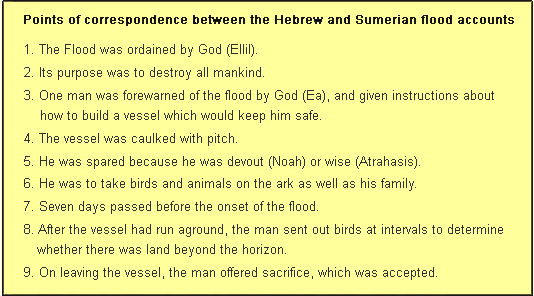
SAfter further study, the tablet was established to be part of a much longer work about Gilgamesh, king of Uruk. Named after its hero, the epic exists in several versions, some going back to the 2nd millennium. Gilgamesh, a historical figure from the mid 3rd millennium, is introduced as the king who ‘restored the cult-centres destroyed in the Deluge’, as if the Deluge had been a relatively recent event. Towards the end of the poem he meets Utnapishtim, the Noah-like survivor of the disaster, and it is he who tells about the event. Here the narrative derives from another Akkadian poem, Atrahasis, not discovered until 1985. Like Genesis, though still composed as epic rather than straight history, that work places the Deluge in the context of a much more distant time.
Atrahasis opens with a description of a world inhabited by gods. Heaven, earth and the underworld have been divided among the three chief gods, Anu, Ellil and Ea. Formerly, Anu’s children lived on earth; now they live with him in heaven, from where they compel the Igigi, Ellil’s children, to dig out the Tigris and Euphrates. After 3600 years the Igigi rebel, set fire to their tools and march on Ellil’s palace in Nippur, central Mesopotamia, to urge him to make their lives less burdensome. It is night when they arrive. Roused from his bed, Ellil prepares to fight them, but his vizier suggests he first summon Anu and Ea and seek their counsel. Anu proposes they create another being to carry out the work. Ellil agrees. So they slaughter one of the gods and mix his flesh and blood with clay to make a man, complete with soul. Man, however, proves a mixed blessing. He produces too many children and becomes so numerous that his noise stops Ellil from sleeping. After vain attempts to reduce the population by disease and famine, Ellil resolves to destroy the human race by a flood. Privately Ea disapproves. He tells one of his worshippers, Atrahasis – another name for Utnapishtim – to build a vessel in which birds, cattle and wild animals can be saved. Atrahasis obeys.
On discovering that he has been thwarted Ellil is furious. Ea propitiates him by instituting less drastic measures to limit the post-flood population: famine, wild animals, war, baby-snatching by demons. Death from old age was not enough, an indication, supported by the fantastic ages of the Sumerian King List, that men before the Flood lived to much greater ages than now. In the Gilgamesh version one man, Utnapishtim himself, is granted immortality.
Thus, while the similarities are significant, so are the differences. Gilgamesh and Atrahasis are inherently fictionalising. Historical events serve as raw material for the poet’s art, which, like a modern film-maker’s, is licensed to embroider and reweave. There is no obligation to be true to source. The deliberations of the gods are dramatised, one god pitted against another, and it is beside the point to ask how the poet could have known what they said to each other. We are dealing with entertainment, not history. Genesis is written in dry, historical prose. The motive for telling about the Deluge lies in the story itself: the event was momentous, and what it revealed about the righteousness of God, Creator of the world, was compelling reason not to replace truth with fiction.
After the Deluge, God granted man a second chance, and that knowledge helped him to understand his present existence. There is no similar sense when we read Atrahasis. The subject matter is valueless for understanding the human condition: if the story has any meaning, it is that life has no meaning. The gods are selfish and capricious, divided in their counsel, false to one another and to man. Far from being all-knowing, Ellil is unaware of his sons’ dissatisfaction and fails to foresee that creating man might not be to his advantage. In Genesis the storyteller’s art serves the purpose of the history; in Atrahasis the history serves the storyteller, who therefore includes, modifies and alters whatever of the facts he likes. The conditions for preserving the original story intact have gone.
Hence a third possibility, rarely considered by scholars, is that Atrahasis and Genesis are similar because they derive from a tradition common to both peoples. Although Genesis is the younger of the two texts and thus even further away from the historical Deluge, factually it is closer. Aware that polytheism had distorted the truth about God and the history of the world, the author took care not to fictionalise or embellish. Pagan authors, by contrast, were promiscuous. They drew upon a common stock of narrative themes which they ‘used in different stories, and adapted in various places for diverse gods’ (Dalley 2000, p 204). Polytheism was fictionalising and plagiarising at its core.
Polytheism in Sumer grew out of monotheism. Until the Late Uruk period, the country knew only two gods: Anu, with a temple at Uruk, and Ea, with a temple at Eridu, to the south-east. Later they were joined by a third, Ellil, worshipped at Nippur. The lesser deities did not appear until after them, increasing in number like a human family as theologians assigned them parentage from pre-existing gods.
In the ancient world the gods were in principle knowable. They had names. Anu, Ea and Ellil were originally different names for the same deity. Anu meant ‘Heaven’, an impersonal synonym for God; his personal name was Ea, pronounced, and sometimes written, as Ay-a (Roberts 1972, Leick 1991). Ellil was a duplication of the Semitic word il, as in Eblaite texts, where the name had the form il-ilu. The duplication signified that he was the one, self-existent God before all others, the ‘god of gods’, just as Hebrew used the plural form Elohim to refer to the one God. The god of heaven was a person, not an impersonal force.
TAmong the Israelites God’s proper name was Yahweh, the name by which he revealed himself to Moses (Ex 3:15, 6:3). Abraham, when he called on his name after building an altar between Ai and Bethel (Gen 12:8), must have known him by a different name. The references to Yahweh in Genesis are editorial and retrospective: Abraham was calling on the one whom Israel later came to know as Yahweh.
To make it clear that he was the deity whom Israel’s ancestors knew as Yah, Yahweh instructed Moses to tell the Israelites, “I am has sent me to you.” ‘I am’ in Hebrew was ehyeh (infinitive: hayah), equivalent to Akkadian Ayah, and Ya(h) was a West Semitic contraction of the word. Ea, or Aya was his name in East Semitic. Like Yahweh, it was derived from the verb ‘to be’, and meant ‘He who is’.
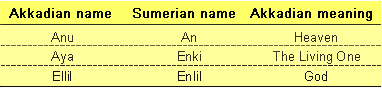
Early in the 3rd millennium the Mesopotamians began to dismember the one transcendent Creator, allocating different parts of the creation to a multitude of gods. In its prologue, Atrahasis mythologises the process by characterising the universe as an inheritance for which they cast lots. The god of heaven, called Anu as if this were his proper name, was given the highest part, Ea was allocated the subterranean earth and the watery Apsu (the great deep), Ellil, now also treated as a proper name, took charge of the subaerial world between heaven and the Apsu, his name being also treated as a proper name. In the person of Ellil, God lived at the same level as man in a world from which he was no longer estranged, in the holy city of Nippur.
All three took on the nature of carnal human beings. In an effort to bring order to their genealogical relationships, and since there were no older gods, Anu was made the father of Ellil and Ea by Ki, or Earth, the sister of heaven. The progeny of Anu and Ki were then called Anunnaki. Like their parents, they united with each other to produce sons and daughters, who in turn begot more deities. The deities functioned as proprietors and guardians of Mesopotamia’s now competing cities, patrons of the powers and attributes that gave civilisation its lustre. As the human population grew, so did the divine population, until by the mid third millennium the pantheon, according to one list, totalled around five hundred, a huge number, even if some names referred to the same deity. By the end of the second millennium there were around two thousand.
Did the work, bore the loads,
The gods’ load was too great,
The work too hard, the trouble too much.

The great Anunnaki made the Igigi
Carry the workload sevenfold.
Anu their father was king,
Their counsellor warrior Ellil.
Their chamberlain was Ninurta,
Their canal-controller Ennugi.
They took the box (of lots),
Cast the lots; the gods made the division.
Anu went up to the sky,
[And Ellil] took the earth for his people (?).
The bolt which bars the sea
Was assigned to far-sighted Enki [Ea].
When Anu had gone up to the sky,
[And the gods of] the Apsu had gone below,
The Anunnaki of the sky
Made the Igigi bear the workload.
The gods had to dig out canals …
In the original account too there are sons of God before the creation of man (Job 38:7). IMore commonly they are called messengers, or in Greek aggeloi, from which we get the word ‘angel’. Much later, three of them visit Abraham and give him the message that in one year’s time his wife will bear him a son. They are described as ‘men’ (males), because that is how they appear; they are not visualised with wings. When food is put before them, they eat it. Since human beings, male and female, are made in the image of God, the sons of God are capable of mating with human beings and fathering children (Gen 6:2–4). They have spiritual bodies, such as all people of faith will have when they rise from the grave (Matt 22:30, I Cor 15:44). Thus the originals behind the Anunnaki in Atrahasis are the angels, the sons of God, and the originals behind the Igigi are the sons of Adam. The Igigi are ‘instead of man’ in the quite literal sense that they have replaced men in the narrative.
 In Genesis, God forms man from clay and animates his body by breathing into it something of his own life (2:7, 6:3). The word ‘image’ (‘in his own image, after his likeness’) has a physical sense, meaning the body in which God manifests himself when he walks in the garden. In blessing the human couple, he grants them and their descendants dominion over the earth and over every animal Starting from the garden which he sets up for them, they are to turn the whole earth into a garden, and be fruitful themselves, to bear children and multiply.
In the new theology, man is fashioned partly from clay, partly from the flesh and blood of a god. In this way ‘god and man will be mixed together’, the god’s death ensuring that an intelligent soul will live inside the creature. Not even the high gods are capable of creating life de novo. The details are comprehensible only in the context of the tradition that the myth replaces; by themselves they make little sense. If the gods are immortal, they cannot be killed, and logically man cannot be the product of a fusion in which he is one of the creatures fused. Man is made in the image of an unknown god and created to be the gods’ slave. The only mortal truly combining both natures is the king. Standing between man and god, and charged with ensuring that the gods – mysteriously present in the human-like effigies that man makes for them – are clothed, housed and fed. To that end, he requires the services of craftsmen, builders, farmers, administrators, tax collectors, priests. He is given dominion – kingship – not only over the animal world but over his fellow man. Sacrifice, whether animal or cereal, is not an act of atonement or of thanksgiving, but the means by which the gods get their sustenance. If they are not fed, the land and its people will suffer. The whole economy is organised round the temple and the king, the gods’ representative.
In Atrahasis God (Ea) does not create man personally; he delegates the task to Ninhursag, here called Belet-ili (‘mistress of the gods’) or Nintu (‘lady of birth’). Again, her involvement is incongruous. Although she is characterised as a womb-goddess, the man does not issue from any womb. Ninhursag’s mediation becomes explicable only when we turn to Genesis and recognise that her prototype is Eve. The first woman has been deified. Ninhursag’s true identity is also clear from two other of her titles, ‘mother of the gods’ and ‘mother of all children’, again showing the equivalence of gods and men in the epic. In Genesis, Eve is ‘the mother of all living’ (Gen 3:20), because she has been created with the ability to procreate. She is the ancestor of all human beings.
In Genesis, man is told to subdue the earth for his own benefit. He is to ‘work’ the ground, the Hebrew verb abad connoting a sense of serving or working for another. He labours to feed himself, his wife and his children – not the gods and the human beings appointed to look after the gods. If tilling the ground turns out to be burdensome, it is because sin has spoiled the creation; work itself is honourable and good.
God tells him to multiply and fill the earth, even though he is mortal. The only way he can become immortal is to eat of the tree of life, but to that he gives no thought. Instead, he – the man and the woman – eats of the tree of the knowledge of good and evil. Having been created godlike physically, he becomes godlike in spirit through getting to know the difference between right and wrong (3:22). Such knowledge, it is found, comes primarily through transgressing against one’s Maker rather than another human being. The disobedience seals his death. Before he can eat of the tree of life God drives him out into the natural world, where he has to toil for his bread. In due course, and as forewarned, he returns to the dust from which he came. God meanwhile stays in the garden. His rest has been disturbed and he will never rest again.
In Atrahasis God – Ellil – dwells on earth in a palace. He does not merely rest but sleeps, every night, in a bed, and his main concern is that his sleep should not be disturbed. He puts no limit on man’s longevity. Man’s filling the earth unchecked is unforeseen. Disease and famine (not mentioned in the Genesis account) are insufficient ad-hoc attempts to deal with the noise problem by suppressing merriment and childbirth rates. Such measures continue after the Deluge, but the problem of how to explain man’s mortality – the gods being immortal – is not addressed.
Whose ear was open to his god Enki.
He would speak with his god
And his god would speak with him.
Atrahasis made his voice heard
And spoke to his lord,
“How long (?) [will the gods make us suffer]?”
Will they make us suffer illness forever?”
It is also striking that Genesis describes a world very different from the one which existed when the account was written down. Though most of the names are familiar, the geography is not. The river flowing out of Eden branched into four, whereas the present Tigris and Euphrates do not branch from a single river, and Pishon and Gihon are difficult to identify at all. Pishon flowed round the borders of Havilah, Gihon round the borders of Cush. In the postdiluvian Ancient Near East, Havilah was probably part of Arabia and so named after the descendant of Shem who settled there (Gen 10:29); Cush, on the other side of the Red Sea, was Ethiopia/Sudan, named after a descendant of Ham (Gen 10:6). Neither territory was bounded by a river. The individuals themselves were named after individuals in the first world after whom territories were named.
The geography was different because the land had been totally destroyed. When the colonisers of the Ancient Near East thought about what to call their new lands and settlements, they chose names that harked back to the first world, conscious that in spreading across the earth they were doing what men had done once before. They were reclaiming and recreating that world, much as European settlers of North America and Australia did with their place names (New England, New York, Boston, Plymouth and the like).
and not raise flood-water from the springs!
Scholars have long supposed that Mesopotamia’s Deluge was inspired by the experience of an exceptionally devastating overflow of these rivers, since some descriptions give the account a distinctly local character. But the details conflict, as if two events – one regional and recent, the other global and ancient – have been conflated. The required countermeasures point to more than just a regional disaster. Atrahasis must build a boat with six decks, and bestow on it wild beasts and cattle, even birds: ‘the seed of all living creatures’. Even if it is not spelt out (some lines are missing), the implication is clear enough: Ellil intends to destroy all life and leave no survivors. Although Ea cannot prevent the destruction, he can at least ensure that the earth afterwards will be restocked.
Gilgamesh gives us the boat’s dimensions: a gigantic cube with sides all measuring 120 cubits (60 metres). Such a vessel would have been prone to rolling vertically and spinning laterally and cannot be taken seriously. In other respects it seems to be a larger version of the open, high-prowed boats that plied the Tigris and Euphrates, for it is launched onto a river and it has paddles. Like storybook depictions of the vessel today, the details are inconsistent. The Hebrew record speaks of an ‘ark’ rather than a boat, using an Egyptian loan-word that means ‘chest’ and otherwise only occurs in the account of Moses’ being cast adrift on the Nile. (The ‘ark’ containing the tablets of the Mosaic covenant was denoted by a different word.) The vessel is 300 by 50 by 30 cubits, has three decks rather than six (being half as high) and would have resisted pitching and spinning (Collins 1977). The design is nautically credible, despite the Israelites not being a seafaring people.
The landing of the cube on Mount Nimush – after only seven days – is similarly incongruous. According to one Assyrian text the mountain lay southeast of the Lower Zab, a tributary of the Tigris, in which case it was probably Pir Omar Gudrun, rising to 2600 metres. Be that as it may, had the floodwaters reached even the foothills of the Zagros Mountains, Sumerian civilisation would have been wiped out. There would have been no restoration of cult centres and no renewal of Uruk’s kingship (Gilgamesh I, 43-44), merely a depopulated wasteland. Also incongruous is the detail that the boat landed on a mountain is completely foreign. So is the detail that Utnapishtim waited seven days before sending forth a dove and a further unspecified number before he sent forth a swallow and a raven. Since he could not see land, the implied depth of water only makes sense in the context of a universal inundation.
For all its inconsistencies and Mesopotamian colour, Atrahasis is a story concerning the whole human race. It explains in Mesopotamian terms why mankind was created, and why mankind had to be destroyed. The Deluge is total: escaping to higher ground is not an option for any animal. Ellil is angry because a purposely constructed vessel has enabled small group to survive (who specifically is not stated; in Gilgamesh they are ‘all my kith and kin’ plus the craftsmen who built the boat). Death, no longer just the consequence of disease and famine, is instituted as the normal end to human life. In such a context the Deluge had to have been universal. The same applies to the tradition which tells of it. If the Deluge was a real event and perceived as affecting all mankind, it is difficult to see how the tradition could have originated in the experience of a merely regional disaster.
The primeval tradition of all mankind
Evidence from other continents that Genesis reflects a once universal tradition.
The chronology of Genesis 7-8.
Further evidence, both Hebrew and Sumerian, that the cataclysm described in Genesis chapters 7-8 was a unique event.
A record of Earth’s recolonisation
How the rocks beneath our feet present a record consistent with the historical record.