 Did the solar system begin naturally or supernaturally? As with the origin of the whole universe, it’s one of life’s ultimate questions, and the way for science to address it is to investigate first the possibility of a natural origin. If a natural explanation cannot be found, that inability may be accepted as evidence of a supernatural origin – provided, of course, that enough facts exist on which to base a judgement, as is surely the case now.
Suppose that everything began with an act of creation. Would we, at least in principle, be able to deduce that that is how things began? Or could the long chain of causes leading up to the present have been initiated at any time? If the latter, a scientist might retrace the chain back to the moment of creation and not know when he had arrived, instead continuing to go back into a past that never existed. The solar system would have appeared to have a past that did not occur, like a drama beginning in medias res. Essentially, this was the problem that troubled the 19th-century naturalist Philip Gosse: the necessity of creating things with apparent age. It seemed to inhere in the very notion of creation.
But the problem is misconceived. Creation in the fullest sense implies bringing into existence that which cannot, of itself, come into existence and therefore cannot be construed as having had a natural origin. It takes place at the point beyond which the chain of causation cannot be pushed back further. Consequently, anything that appears to have a history should be accepted as having a history. That the solar system had a supernatural origin is neither ruled out nor assumed; instead, we test for the possibility by exhaustively exploring the opposite presumption. Since Genesis says that it was created, those who believe in the authority of that text must stake everything on the prediction that naturalistic attempts to explain the solar system’s origin will fail.
 It might be argued that science and theology are complementary. The creation account simply reveals those things which we cannot discover by human reason, for example, that the entire solar system was created in six days and that the Earth is older than the Sun. But human reason recognises no limits. Philosophy, including what we now call science, is the practice of asking fundamental questions about existence independently of authority, and the presumption is that the solar system formed naturally; otherwise, reason would have no role to play. In practice that entails some version of the nebula hypothesis. Already in the 17th century René Descartes proposed that the Sun and planets had condensed from a contracting vortex of particles. In the 18th century Immanuel Kant proposed a cloud of aggregating particles, and Pierre-Simon Laplace greatly enhanced the idea’s credibility by fusing it with his work on celestial mechanics. Laplace claimed to be able to account for the motions of the planets without having to postulate that the Creator periodically intervened to restore order. As he famously said to Bonaparte, “I have no need of that hypothesis.” Scientific explanations of phenomena had to be based on the laws and properties of nature.
But astrophysics is never entirely divorced from metaphysics. Kant thought that Jupiter and Saturn were probably inhabited by creatures more intelligent than human beings, and even today NASA scientists believe that they might find unintelligent life on Mars or Jupiter’s moon Europa. More presciently Kant postulated that the tiny ‘nebulae’ observable through telescopes were ‘higher universes’, galaxies much like the Milky Way. In the early 20th century that idea proved correct.
Despite the vast amount of information gathered about the solar system in recent decades, the basic picture of how it began remains unchanged. Initially there was a rotating molecular cloud of dust and gas. The ‘dust’ was a mixture of silicates, hydrocarbons and ices, the gas mostly hydrogen and helium. Over time collisions averaged out the vertical motions and flattened the particles into a disc. As gravity drew the matter inwards, most of the cloud condensed into a central orb. Gravitational energy turned into heat, intense enough for nuclear fusion to be initiated. At the same time, other matter in the disc clumped into progressively larger units, which eventually amalgamated to form planets.
 The planets can be divided into three types according to their composition: the rocky or terrestrial planets Mercury, Venus, Earth and Mars, the mainly gaseous planets Jupiter and Saturn, and the so-called icy planets Uranus and Neptune. Actually, because temperature increases with pressure, the gases and ices are hot, dense fluids, and the planets may not be rich in water at all (Helled & Fortney 2020). Further out is an array of icy ‘Trans-Neptunian objects’ (TNOs) such as those making up the Kuiper Belt (Fig. 27). The Kuiper Belt was only discovered in 1992 but is a major component of the solar system. Pluto, its most famous member, was discovered in 1930. Smaller than Earth’s Moon, it was demoted in 2006 to a dwarf planet because its gravity was not sufficient to clear its orbital neighbourhood of other large bodies. Pluto is about one third water ice and two thirds rock, and orbits the Sun in the same region as the Kuiper Belt.
Asteroids (‘star-like’ bodies, from the Greek word aster) are scattered all over the solar system, ranging in size from several hundred kilometres in diameter to mere pebbles. More than 10,500 over 140 metres in diameter lie between Earth and Mars and are known as Near-Earth Objects; above 1 km in size around 900 have been counted. Asteroids in the main belt between Mars and Jupiter are more difficult to count because they are further away, but those above 1 km number probably at least a million. There are also irregularly orbiting asteroids called centaurs between Jupiter and Neptune and a host of TNOs between Neptune and the edge of the solar system. A few of the centaurs and some of Neptune’s moons may be TNOs that were disturbed from orbits originally in the Kuiper Belt. Some eventually drifted further across towards Jupiter. This appears to be the explanation for the arrival of comets in the inner part of the solar system: they are TNOs drawn in from the Kuiper Belt and beyond.
The rock-gas-ice sequence of the planets is attributed to the disc’s temperature gradient. Close to the Sun, where it was warmer, solar winds drove away most of the gas, so that only rocky bodies could form, and these ceased to grow once there were no more smaller bodies in their orbital neighbourhoods to amalgamate with them. The Earth-Moon system reached its present mass in about 100 million years, or maybe 40 million years. Asteroids, seen as leftovers of planet formation, continued to pockmark Mercury, Mars and the Moon for considerably longer, and indeed, throughout the solar system, impact craters are visible on every solid surface that has not been recently resurfaced. Further out, where it was colder, rocky planets grew to even bigger sizes. The more volatile elements gravitated and condensed around them, and in this way Jupiter, Saturn, Uranus and Neptune formed.
Asteroids are thought to have been prevented from gaining further mass by the sparsity of the remaining material. The idea can be tested by estimating how much material would have existed in the relevant regions if its spatial density was the same as needed to produce the planets elsewhere (Bottke et al. 2005).
Estimates can be made using the assumption that the nebula contained just enough material of solar composition to form the planets at their current locations and compositions. These model results suggest that the Solar System’s surface density may have varied as r-1 to r-3/2 between Venus and Neptune, where r is heliocentric distance [distance from Sun].
That is, according to these two-dimensional models, the density of the particles would have declined exponentially with distance and progressively less steeply.
Compared to this prediction, however, the amount of solid material in the main [asteroid] belt zone today is nearly 1000 times lower than our expectations. This is a serious problem.
The belt’s mass has since been revised downward to less than 1/2000th that of the Earth (Morbidelli et al. 2015), doubling the amount missing. Also, many of the asteroids are thought to have drifted in from the outer solar system, so that the original number would have been considerably smaller. A similar ‘missing mass problem’ concerns the Kuiper Belt, the estimated mass of which is 500 times less than expected – a mere one fiftieth that of Earth.
Thus explanations have to be found for (i) why the objects in these regions failed to accrete, despite having a total mass 500–2000 times greater than now, (ii) how more than 99% of their present mass might subsequently have been lost. Almost from the start, asteroids and TNOs have generally been getting smaller and smaller, not larger and larger, as a result of colliding with each other and grinding each other down (Stern & Colwell 1997).
In the case of the Kuiper Belt, its primordial density has to be reconciled with the density required for the Scattered Disc beyond the belt and for the Oort Cloud (the inferred source for long-period comets) far beyond the Scattered Disc. Drastic erosion of the Kuiper Belt as a result of collisions seems inescapable. On the other hand, the same process that depleted the Kuiper Belt must also have depleted the Scattered Disk and Oort Cloud and left the latter with a population incapable of supplying comets over billions of years (Charnoz & Morbidelli 2007).
In contrast to the main belt asteroids and TNOs, Uranus and Neptune have too much mass. At their distance from the centre, the disc is thought to have been too thin to generate such bodies, and modellers have to suppose that they formed much nearer the sun and later migrated outwards, possibly swapping places in the process. Another problem is how the terrestrial planets acquired their mass. Collisional erosion of the clumps of matter between present-day Mercury and Mars should have inhibited planetary formation, just as erosion inhibited the growth of the asteroids between Mars and Jupiter. Even if this is ignored, standard models end up with a Mars much bigger than the real one plus addi¬tional Mars-sized embryos in the asteroid belt (Izidoro et al. 2015, Tsiganis 2015). It is also clear why there are no rocky planets nearer the Sun than Mercury.
Since refractory elements in the nebula would have condensed out before volatile elements, the formation of the gas and ice giants is believed to have taken place in two stages: first the accretion of a rocky core, then gravitational condensation of gases around the core. However, in such a case the cores of Uranus and Neptune would have taken longer to accrete (more than 10 million years) than the disc supplying them with material could have been in existence. Models vary, but relative to total mass the cores of these planets could be quite small. If so, how did they accrete so much gaseous material this far out? How Uranus and Neptune attained their mass is a long-standing problem for planet formation theory (Helled et al. 2020).
The rock component of Jupiter and Saturn amounts to 10–30 times and 15–18 times Earth’s mass respectively (Miguel et al. 2022, Iess et al. 2019). Jupiter as a whole is anomalously large, with a mass exceeding that of all the other planets put together. That the rock buried within Jupiter and Saturn is diffuse is also problematic. Before the results of the Juno space probe came in, astronomers inferred from their models that the planets had either a very small and dense core or no core at all. The proposal now is that Jupiter’s core began compact but was subsequently added to by collisions with other rocky protoplanets.
The high mass of Jupiter’s rocky core only aggravates the problem of missing mass in the asteroid belt. The amount of solid material is predicted to have decreased at distances further than the Earth, the most massive of the four rocky planets, so where did Jupiter’s rocky core of 10–30 Earth masses come from (Morbidelli & Raymond 2016), especially when the protoplanetary disc at this distance was dominated by gas? It seems simpler to suppose that the core derived from a planet that exploded in its vicinity, at a time when Jupiter consisted solely of gas. It accreted its rock as fragments from the explosion were drawn in by its enormous gravity. This would explain why the core is so diffuse. It would also explain why the orbits of some of the asteroids – fragments that did not get sucked in – are eccentric and at high inclinations. The radial distance between the Sun and Mars is less than half the distance between Mars and Jupiter, so there is certainly space for another planet. Saturn, similarly, might have acquired its core from a second exploded planet between Saturn and Uranus, giving rise to the asteroids in that part of the solar system.
 The rocky Kuiper Belt objects, among them the dwarf planets Pluto and Haumea, might be the remains of a third exploded planet. One of the peculiarities of these objects is that their orbits are both more inclined and more elliptical than those of the major planets. Some even orbit in the opposite direction. In the words of Bernstein et al. (2004), ‘the TNO popula¬tion only vaguely resembles the preconception of a dynamically pristine planetesimal disk.’ The Scattered Disc might be the remains of a fourth exploded planet. That would make 8 surviving planets and 4 shattered ones, the same number as in Joseph’s dream.
Another problem with the core accretion model is that the same spiralling in of matter to form the Sun also drew in the growing planetesimals. As has long been known, frictional and gravitational interaction between the gaseous disc and the rocky planetesimals would have caused the latter to migrate inward, and the time involved, about 100,000 years, is much shorter than that needed for accreting gas to produce the giant gas planets. The growing planets would have plunged into the Sun before they had time to reach their present size. This was confirmed by Paul Cresswell and Richard Nelson (2006) in more sophisticated simulations. The simulations show large-scale migration of bodies towards and into the star, with their orbits changing as they approach from strongly elliptical to circular.
The problem is also acute for smaller bodies, from 10 cm diameter to a few metres. The point here is that solid particles in the nebula orbit at speeds substantially greater than the surrounding gas. As they move through it, they become subject to a head wind, lose their orbital energy to gas drag and drift inwards. At one Earth-distance from the Sun the rate of migration is of the order of only 100 years (Armitage 2007). On average, particles that reach metre size have not much more than 1,000 years to make the leap to planetesimal size, above 1 km, when gas drag ceases to be a factor. Once the Sun approaches its maximum mass, thermonuclear fusion generates a strong stellar wind which clears the inner solar system of gas and dust.
Laboratory and microgravity experiments such as those performed on the International Space Station show that millimetre-size particles will spontaneously coalesce into loosely bound 1–5 centimetre clumps very quickly, and growth can be modelled up to metre size. Sticking is promoted by electrostatic forces, also by frost if present. Beyond that, aggregation can be frustrated by even a small amount of turbulence as collision effects turn from sticking to bouncing, or even disaggregation. Gravity becomes an appreciable force only beyond about 1 km diameter. Because of this ‘metre-size barrier’ the process leading to the formation of planetesimals is ‘somewhat murky’ (Armitage 2007). This is not to say that it could not have happened. It is clear from the low-density asteroids known as ‘rubble piles’ that larger-scale aggregation does – or at least did – occur. While their bouldery material consists of collision debris and therefore does not support the nebula idea, they at least give evidence of secondary aggregation. One example is Sylvia, a lumpy potato-shaped asteroid 380 km across. Another is Dinkinesh, just 790 m wide. Both Sylvia and Dinkinesh have their own satellites, showing that gravity does not automatically bind asteroids together. Mars’s tiny satellite Phobos is also a rubble pile.
Once bodies reach 100 km, the currently favoured explanation for how they form is ‘pebble accretion’ (Johansen et al 2015). A continuing problem is the occurrence in some meteorites of millimetre-sized condensates termed CAIs and chondrules. Dating studies suggest that CAIs existed separately in the nebula for up to 3 million years before accreting with chondrules and other constituents to form larger particles. Such a long delay is ‘incompatible with dynamical lifetimes of small particles in the nebula and short timescales for the formation of planetesimals’ (Weidenschilling et al. 1998). Moreover, pebble accretion should result in the largest rocky planets forming closest to the Sun and the smallest forming beyond Saturn (Morbidelli & Raymond 2016), whereas the gas giants each have more rock than all the terrestrial planets put together.
 When Galileo in 1610 looked at Jupiter through his telescope, he was amazed. He had simply expected to get a closer view of an object whose existence was already known; he had not expected to see four previously invisible satellites. Not only was the Earth’s position in the solar system not unique, but the Moon was not the only moon.
In fact, more than 200 such satellites exist. Those with comparatively tight, circular, equatorial orbits round their host planet are classified as regular satellites. While surprisingly diverse, most are believed to have formed in the same region of the primordial disc as their host. The largest – Titan and Ganymede – are larger than present-day Mercury, albeit not as massive. The irregular satellites are distinguished by their more elliptical orbits, their smaller size and their greater distance from the planet. They are thought to have originated elsewhere in the disc and later been captured. Some irregulars may be products of a collision that shattered a larger moon. Mercury and Venus, being relatively small and closest to the Sun, have no moons. Earth has one, Mars two (both irregular), Jupiter 8 regular and, at the last count, 84 irregular, Saturn 24 regular and 121 irregular, Uranus 18 regular and 9 irregular, Neptune 7 regular and 7 irregular. Many of the more recently detected moons are less than 3 km across. Unlike their hosts, the largest moons of Jupiter, Saturn, Uranus and Neptune are predominantly rocky; the rest are entirely rocky.
Genesis does not explicitly say anything about what is not visible to the naked eye. It focuses on the solar system, the space delimited by the envelope of water that enclosed the Earth, Sun, Moon and ‘stars’. The modern reader assumes that the latter were the stars of the Milky Way. However, it would be a mistake to read Genesis 1–2 in isolation, for other parts of the Bible show that the Hebrews believed the heavens to be bipartite, consisting of a ‘firmament’ and a much bigger heaven beyond the firmament (Deut 10:14, I Ki 8:27, Ps 148:4). They would have perceived well enough, therefore, that the stars made on the fourth day were the wandering stars. When Nehemiah summarised what God did at creation, he proclaimed, “You made the heavens, the heaven of heavens and all their host, the earth and everything on it, the seas and everything that is in them.” The host of the numberless fixed ‘stars of the heaven’ lay in the heaven above the firmament.
Accordingly, while creation theory predicts that the origin of the Earth’s moon will not yield to a natural explanation, it makes no predictions about the non-luminous, non-visible other moons. We may readily infer that the irregular satellites are not primordial, and those that are irregular in shape as well as orbit cannot be, but what about the regular satellites? The answer is probably also not, though it is conceivable that some were created. Spherical shape is not itself a sign of creation, since, above a certain mass, gravity will of itself cause a body to assume a spherical shape. If none of the moons were created, then, like the rocky material forming the cores of the gaseous planets, they must be the remains of planets that exploded.
 The diversity is well illustrated by the four large satellites that Galileo saw around Jupiter. Their greater rockiness in order of closeness to Jupiter is evidence against their having originated in the same process as the planet. Io, the densest and innermost of the four, has a substantial iron core and a solid, mountainous crust. Tidal stresses produced by Jupiter’s gravity and the opposite pull of moons orbiting further out cause Io to be volcanically active, inducing the eruption of sulphurous gases and of so much magma that the moon has been completely resurfaced. Europa has a frozen, smooth surface criss-crossed by dark streaks, beneath which tidal flexing maintains an ocean of water up to 100 km thick. Scientists who believe in spontaneous generation, a popular idea before Louis Pasteur, speculate that there could be life in this water. Ganymede is the largest moon in the solar system, larger even than Mercury, and has an icy shell 800 km thick. The surface is a patchwork of very old, highly cratered dark regions and younger lighter regions marked by grooves and ridges. Beneath the shell is a rocky mantle and a small, partially molten core, which generates a strong magnetic field. Callisto, the outermost and least dense of the four, consists of about 40% ice and 60% rock. It is among the most heavily cratered satellites in the solar system – evidence, as with Ganymede, that it is very old. Estimated accretion times for the four moons range from 10,000 to 100,000 years.
Apart from Mars’s two tiny moons, the only terrestrial planet to possess a moon is the Earth. According to Genesis, Earth’s moon was created in order to divide the year into months and alleviate night’s darkness. Unstated purposes would have included the stabilisation of the Earth’s axial tilt and the production of tides.
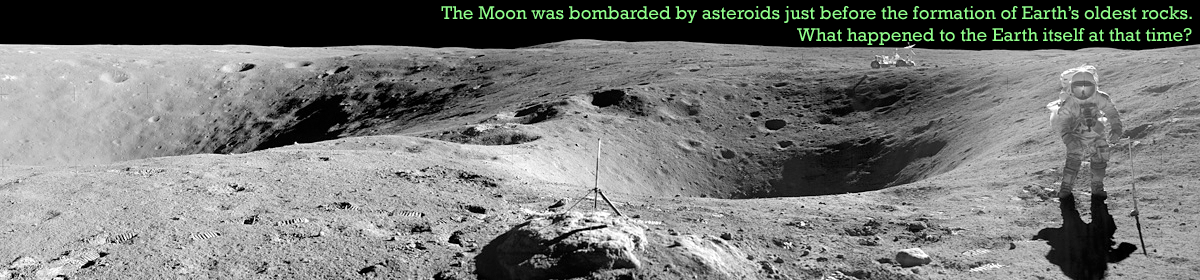
The present Moon is far from pristine. The upper crust consists of an igneous feldspar-rich rock known as anorthosite, igneous in the sense that its mineralogy and texture is that of a rock having crystallised out of magma. The crystalline state implies an earlier molten state, so cosmologists are not being unreasonable when they deduce that the anorthosite must have crystallised from a ‘magma ocean’. The crust is iron-depleted and the core iron-rich, indicating that as the interior melted minerals separated out according to density, with those richer in iron sinking towards the centre. Enormous craters show that the Moon subsequently suffered bombardment by asteroids. In the wake of the impacts, basalt welled up to fill the craters and produced the smooth dark maria that variegate the surface. The indistinct rims of the oldest craters suggest that the crust was hot and still plastic when the first asteroids fell (Kamata et al. 2015, Conrad et al. 2018).
The Moon was volcanically resurfaced, first by internal melting, then by impacts. None of the rocks sampled by the Apollo missions go back to the Creation. Its origin cannot be investigated directly, though one can speculate.
Aggregation from the same part of the nebula as the Earth supposedly came from may be discounted, because the Moon has a smaller proportion of volatiles and iron than the Earth and is 40% less dense. Instead, the leading idea, since 1984, has been that the Earth collided with a smaller planet of different composition which disintegrated and partly vaporised. The debris would have settled into an encircling disc aligned with the Earth’s equator, and most of the debris from which the Moon then emerged would have come from the impactor. In fact, the Moon’s orbit is currently inclined at 5? to Earth’s equator, and calculated to have originally been inclined at 10? (Pahlevan & Morbidelli 2015). Claims to have solved the ‘lunar inclination problem’ have repeatedly been made but as frequently rejected, as the next attempt at a solution points out the deficiencies of the last one.
Since planets differ in isotopic composition, the scenario predicts that the Earth and the Moon will also differ isotopically, but in fact their isotopic signatures are remarkably similar. According to Linda Elkins-Tanton (2013), the Giant Impact Hypothesis is in crisis and ‘creative thinkers’ are required to make it plausible. One suggestion is that the Moon formed from a succession of smaller debris-forming impacts (Rufu et al. 2017), another, that it formed directly from a planet that collided with the Earth without disintegrating into dust and vapour (Kegerreis et al. 2022). Neither of these variations really addresses the compositional problem. Perhaps, then, the giant impactor was isotopically similar to the Earth (Dauphas 2017) and one just has to accept that this is statistically unlikely? While one can never say never, as things stand the Moon’s ongoing resistance to natural explanations constitutes evidence that the satellite did not have a natural origin, even though the search goes on.
Meanwhile, dates for the hypothesised Moon-forming impact – which cannot be dated directly – also vary, there being many uncertainties. One estimate, based on modelling the loss of volatiles after the impact, puts it around 4.4 Ga, later than most previous estimates (Connelly et al. 2022). An upper limit is provided by the oldest rock fragment retrieved, which yielded a ‘probable’ age of 4.547 Ga (Fernandes et al. 2013). Another study concluded that the crust had solidified by 4.51 Ga (Barboni et al. 2017). According to the latest review, the crust did not form until around 4.35 Ga (Borg & Carlson 2023). ‘The contradictory nature of much of the chronology stems from a variety of factors including disturbance of ages by secondary processes, calculation of model ages based on myriad assumptions, erroneous measurements, and an ever-evolving understanding of the petrogenesis of the dated samples.’ Although the Moon itself is assumed to have formed no later than 4.5 Ga, no mechanism is known that would keep the Moon in a largely molten state for 150–200 Ma prior to crystallisation.
 Undoubtedly the most significant development in the last three decades has been the observation of planets orbiting other stars in our galaxy, now numbering several thousand. Around the youngest stars discs have also been observed. A spectacular example is the disc around PDS 70 (Fig. 30), a K-type star somewhat smaller and cooler than the Sun and one of only a handful hosting distinguishable protoplanets. The disc consists partly of gas (H, He, and compounds of H, C, O and N) (Facchini et al. 2021) and partly of dust, including silicates, the raw material of rock. Between the star and the disc is a glowing and apparently still growing body, about the same distance from its star as Uranus is from ours, and seven times the mass of Jupiter. Another, at about the same distance as Neptune, is three times the mass of Jupiter. Beyond them both is an asymmetric dust ring. There is also a thin inner ring within 18 AU of the star (1 AU = distance from Sun to Earth), containing dust and water vapour.
At first sight such observations provide a great boost for the nebula hypothesis. There are now statistical grounds for supposing that most stars have planets, and apparently planets do form from rotating clouds of dust and gas, about the same time as the stars form. However, creation theory does not exclude the natural formation of either stars or planets, so their discovery is neutral as regards whether our own solar system has a natural origin. Nor should we assume that the other systems formed in the incremental way that is postulated for our own solar system. The gap between PDS 70 and the main ring is ascribed to the planets’ sucking up disc material as they grew, but this is not beyond question. First, according to mass/volume calculations the planets are less dense than Jupiter, despite being up to seven times bigger, so contain very little rock, and cannot have acquired their volatiles through accretion round a rocky core. Second, the gap is very wide relative to the mass of the planets and the extent of their orbits. Discs consisting of rings and gaps have been discovered round other stars, but the planets assumed to have produced the gaps have not been observed and may not exist; possibly the gaps were not the result of planet formation, and planets do not form by accretion. Third, according to the nebula hypothesis, discs should thin out with distance and become less dusty, whereas the PDS 70 disc is thickest at 80–140 AU, far beyond Pluto in the solar system. And fourth, it may be that the disc or ring is not the remains of a star-forming nebula at all but a product of the star. A bridge-like structure (happening to envelop the further planet when the image was captured) extends from the star in opposite directions all the way to the ring, as if the star were the source of the ring.
Exoplanetary systems can be classified into four groups: ‘similar’, ‘ordered’, ‘anti-ordered’ and ‘mixed’ (Mishra et al. 2023). In similar systems (the most common, about 80% of those surveyed) the planets are of similar size and mass, like peas in a pod; ordered systems (the least common) are where planetary mass tends to increase with distance from the star; anti-ordered systems are where mass tends to decrease; mixed systems are where mass does not correlate at all with distance. In most cases there is only one planet. The highest number observed is eight, around the star Kepler-90. The six inner planets are rocky and all bigger than the Earth; the two outermost are gas giants. All eight lie within 1.1 AU, well within the ‘snow-line’ within which conditions should prevent gas giants from forming. One star, the red dwarf TRAPPIST-1, has seven planets. All are rocky, all less dense than the Earth and all within 0.07 AU of their star.
As regards composition, exoplanets seem to divide into the same three groups as in our neighbourhood: rocky (broadly speaking), gaseous (‘Jovian’) and icy (‘Neptunian’), the distinction between gaseous and icy being a matter of temperature rather than composition. Density (mass divided by volume) varies, and with rocky planets there is considerable latitude in modelling the compositional mix that corresponds to the density. Gaseous planets vary in density partly because they may include rocky material and partly because the more massive the body, the more the gas compresses under its own gravity; in addition, gas density varies as a function of temperature. But overall, exoplanets differ from solar planets not so much in bulk composition (so far as can be determined) as in mass, size and distance from the star.
Mass-wise, rocky (high-density) exoplanets are a distinct group of low mass and radius. Mass tends to increase with distance, but in contrast to the solar system, the vast majority lie at distances between 0.01 and 0.7 AU, and most are bigger than Earth. Non-rocky planets mostly fall into two groups, those orbiting closer to the star than 0.2 AU those orbiting further than 0.5 AU. Beyond 0.1 AU, size is fairly constant, at around 11–13 Earth radii, because cooler temperatures increase the density and thereby counterbalance increasing mass. In the solar system, by contrast, mass tends to decrease with distance. Saturn, Uranus and Neptune all lie far beyond the exoplanet field and evidently formed in circumstances different from those governing their exoplanet counterparts. Rocky and gaseous planets are discontinuous, contrary to what one might expect if both types formed from a disc and the proportion of gas uniformly increased with distance.
Rocky (high-density) exoplanets are a distinct group of lower mass and radius. As with the gaseous planets, mass tends to increase with distance, but in contrast with the solar system, the vast majority lie at distances between 0.01 and 0.7 AU. Rocky and gaseous planets are discontinuous, contrary to what one might expect if both types formed from a disc and the proportion of gas uniformly increased with distance. Most of the rocky planets are bigger than Earth.
The host stars also vary. Some are the same size as the Sun, some bigger, some smaller. G-type stars like the Sun, brown dwarf stars and giant gas planets make up a continuum in terms of size and mass (Chen & Kipping 2017). Gas giants are termed brown dwarfs if they exceed 13 Jupiter masses. Some planets, occurring singly or in pairs, are free-floating: they do not have stars at all, challenging current theories of both star and planet formation (Pearson & McCaughrean 2023).
Gaseous exoplanets can be up to 20 times more massive than Jupiter. The most massive tend to lie beyond 1 AU, but a substantial fraction, with masses of 0.1 up to 11 times that of Jupiter, lie between 0.01 and 0.2 AU of the star, much closer even than Mercury is. Those with orbits shorter than 10 Earth days are dubbed ‘hot Jupiters’ and are highly inflated. Ostensibly, their closeness to the star negates the nebula hypothesis, firstly, because the intense heat at these distances would have prevented condensation and secondly, because the violent stellar winds typical of young stars would have dispersed any that began to form there. The standard get-out is therefore that they migrated to their positions from colder regions. Were that so, one would predict rocky planets to be present, not far removed from them orbitally. In fact, most hot Jupiters are entirely solitary, and in the few cases where they are not, their companions are gaseous, so far as can be inferred (Wu et al. 2023). That all hot Jupiters migrated to their observed positions is completely implausible and mooted only because of the need to make other solar systems conform to the narrative devised for our own, which is manifestly unique. Indeed, our own gas and ice giants are so difficult to explain in their present positions that they are thought to have migrated in the opposite direction, from closer in outwards.
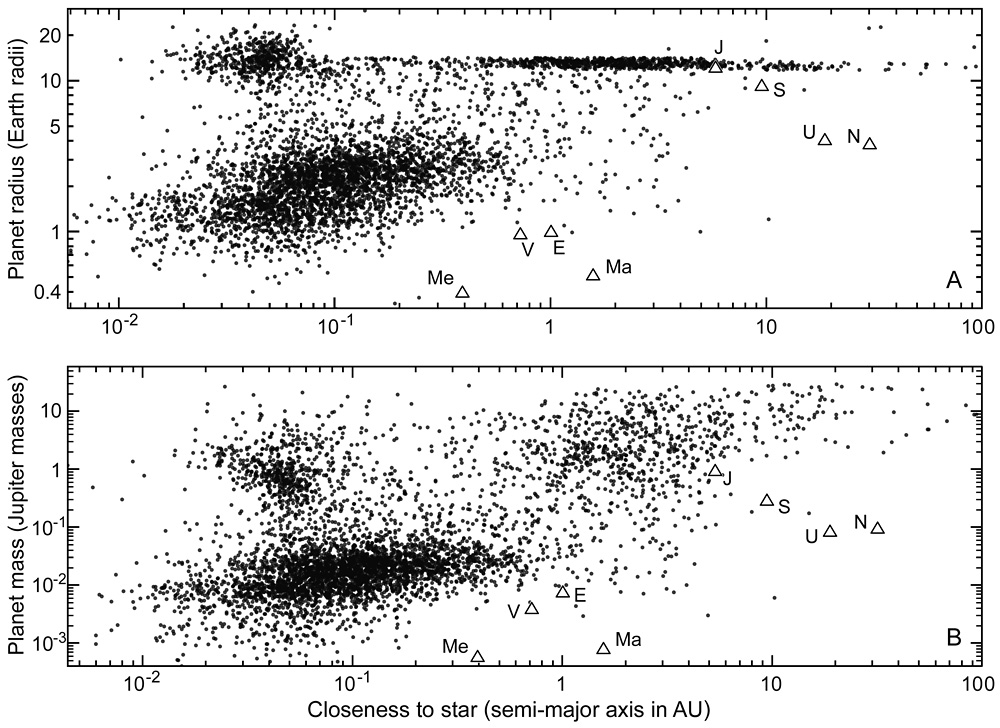
Another contrast with our own system is that the orbits of most of the planets, especially at distances greater than 1 AU, are highly elliptical (in the range 0.1–0.9, where 0 is circular and 1 parabolic). Life requires that the temperature at any latitude be within a narrow range and the orbit therefore be close to circular. Also, some orbit at a high angle to the star’s equatorial plane. A star’s spin axis is difficult to detect, but in a study investigating 57 cases where the axis could be determined (Albrecht et al. 2021) only 14% of the planets orbited at less than 7° to the star’s spin axis, 53% orbited at inclinations between 9 and 37° and almost a third had inclinations of 80–124°. Some orbited in the opposite direction to the star’s spin.
Cold gaseous giants like our Jupiter are comparatively rare. ‘Hot Jupiters’ are common, and their orbits close to their stars suggest that they issued directly from the star rather than from a circumambient disc. If they are migrating, they are as likely to be migrating inward as outward. One planet, WASP-18b, has ten times the mass of Jupiter, orbits its star in less than a day at a distance 50 times closer than the Earth is from the Sun, and is thought to have been spiralling inward over less than 5 million years, much less than the age of the star itself, thought to be 0.5–1.5 billion years old (Hellier et al. 2009). HIP 67522b orbits its star in 7 days, so is also very close to its star, and its estimated age is only 17 million years. KELT-9b has an orbital period of 36 hours and a daytime temperature of 4,300° C, hotter than the surface of some stars. TOI-5205b is disproportionately large compared to its star, which is 39% less massive than the Sun (Kanodia et al. 2023). It is not unique (Bryant et al. 2023, Steffánson et al. 2023), but according to the standard accretion model it should not exist, for the less massive the star, the less massive the disc from which it condensed and the less massive the planets. The obvious explanation is that the planet originated more or less fully formed.
Spectral analysis of a planet’s composition is usually not possible. WASP-76b, one of the exceptions, proved to have roughly the same composition as its star and thus supported the idea that the two had a common origin (Pelletier et al. 2023). Like TOI-5205, many of the host stars are dwarfs. Since the standard model does not work where dwarfs are concerned (Boss 2006), this too suggests a more direct process.
Naturalistic theory predicts that more than a third of the systems with giant planets will turn out to host Earth-like planets, including water-rich planets on stable orbits (Raymond et al. 2006). With the development of instruments capable of detecting even dwarf exoplanets, the prediction has fallen flat. The majority of rocky exoplanets are more massive than the Earth and have much faster orbits. The rocky planet Kepler 10b caused excitement because it had a radius just 1.4 times that of Earth’s. One academic hailed it as “among the most profound scientific discoveries in human history”. However, it was twenty times closer to its star than Mercury and its surface temperature exceeded 1300° C. In 2013 astronomers found a planet, Kepler 78b, with the same mass as Earth – but again, too warm, with a surface temperature exceeding 2000° C and orbiting its star in just 8.5 hours. In 2015 GJ 1132b was hailed as possibly ‘the most important world ever found beyond the solar system’ – but once again it was necessary to read the small print, for its orbit was also too close to its star, a red dwarf, to keep liquid water. In January 2023 NASA announced the discovery of an Earth-sized planet, TOI 700e, that it believed was cool enough for water, assuming that it had an atmosphere to retain it. The orbital range within which water can exist is called the ‘habitable zone’. Whether water does exist on the surface is unknown. To date, no rocky planet has been found with water on the surface. It suits scientists to hype up their discoveries in press releases and journals and have us believe that life is an accident just waiting to happen. While absence of evidence is not evidence of absence of life, it is also not evidence of presence. Creation theory maintains that life, even in the broad sense which includes bacteria and plants, requires creation, and since the Earth was the only place in the universe where life was created (beyond the firmament there were only quasars), predicts that life will not be found anywhere else – not even in our own solar system.
Thus, it remains true that ‘the origin of the Solar System represents one of the oldest unsolved problems in science’ (Taylor 2004). Among the many thousands detected no system resembles our own. It resists a naturalistic solution and, by the same token, suggests a theistic solution, even though we do not see the solar system in its originally created state. The case is not of course closed. In the face of a perceived problem or an unpalatable solution, one may always hope that the key insight awaits discovery. In science, conclusions must remain provisional. Nonetheless, the only data we ever have are the data available now. We have one short life in which to make up our minds and the balance of probabilities assuredly does not suggest that the solar system came about by chance.
The pages following offer an alternative explanation of asteroids, moons and the Kuiper Belt, beginning with
2. A highly disturbed childhood.