Creation
- The world was not designed to last forever. Its initial state was one of maximum order and has ever since been winding down to a state of disorder. It is by nature temporary and ever changing, not a place of rest or stasis.
- Life temporarily runs counter to that trend, in a cycle which attains maximum order in early adulthood and then goes the same way as inanimate creation. From birth to death, organisms are in a state of constant change.
- ‘Evolution’ is biological change, often in the direction of increased specialisation. It is therefore not the opposite of creation but its complement: the capacity of species created at the beginning to adapt to a world in flux.
- The original creation no longer exists, it was destroyed by its Creator, in an act of wrath and judgement. All species known to the fossil record postdate that destruction. They had to adapt to a world that was not merely changing but gradually renewing itself. Indeed, in many respects life itself became an agent of the renewal.
- Creation, by definition, occurs at the beginning. Attempts to match the 6 days of creation to an evolutionary sequence beginning from the moment when, out of the waters, Earth and all its life started again are misconceived.
The story told by the fossil record
- The entire sequence of fossils, from single-celled organisms near the bottom to human beings spreading out of Africa near the top, is the story of a world recovering from a global cataclysm.
- The cataclysm annihilated the land and its inhabitants. It is evidenced not by great depths of sediments, or fossil graveyards, but by the absence of rocks and fossils.
- Marine life appeared before terrestrial life because, under the land, pockets survived. Terrestrial life was totally obliterated. It was re-seeded, as in a new creation, from preserved single pairs of animals that multiplied on new land.
- The cataclysm took place at the end of the Hadean, at the beginning of geological history. That is why, on Earth, the Hadean itself left no geological record, all rocks from that time were absorbed back into the mantle. The oldest preserved rocks are volcanic and show that the process of renewal began under water.
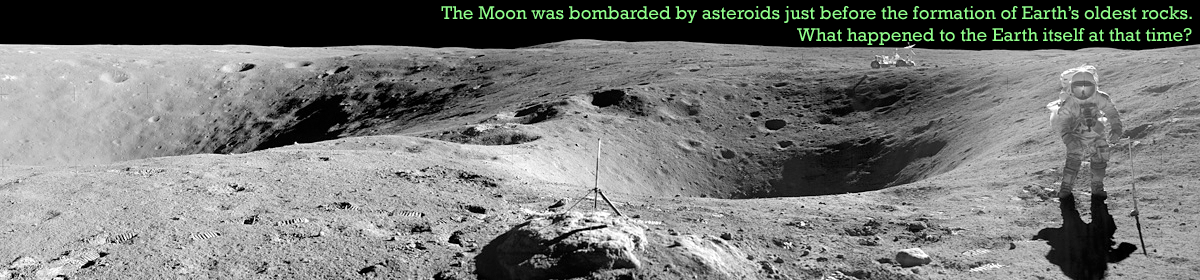
- The effects of the cataclysm are still visible on the Moon, whose ruined surface consists entirely of craters and dark plains of lava produced by asteroids. Earth suffered the same bombardment.
Recolonisation in a nutshell
Diversity over time
The Hadean Cataclysm
The Cataclysm – more than a flood
Recolonisation – some key features
- Global recolonisation can appear like an evolutionary sequence, since initially barren environments mature over time and go through an ecological succession in which later-arriving biologically more complex organisms depend on earlier ones.
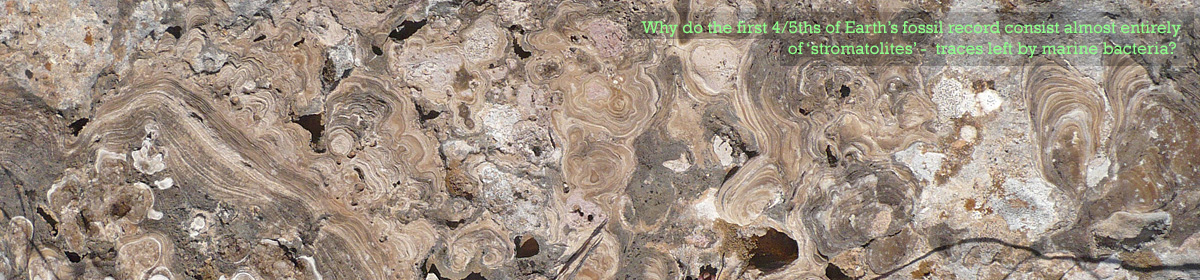
- Crustal rock going back to the Creation does not exist. The oldest rocks, of Archaean age, reflect the generation of new land after the cataclysm. New land continued to form at a high rate during the Proterozoic. Throughout that time oceans were very warm, owing to very high rates of ocean-floor generation. Consequently they were poor in oxygen and in most places inimical to life. At first only bacteria flourished, followed by algae and plankton.
- The ‘Cambrian Explosion’ marks the point at which near-shore environments had stabilised sufficiently to support complex life. In a remarkably brief span of geological time, complete ready-made ecosystems arrived as if from nowhere.
- The recovery of marine food chains continued in the Ordovician, Silurian and Devonian periods.
- A similar succession characterises the recovery of plant life from the Ordovician onwards, beginning with microscopic spores, continuing with various marsh plants, climaxing with great forests.
- The earliest land animals, millipedes, centipedes, arachnids, had no marine precursors. They appear suddenly. All the major insect groups appear suddenly.
- The earliest terrestrial vertebrates had no marine precursors. The first tetrapods were aquatic animals; their limbs and digits did not evolve as an aid to moving on land.
New land in the Archaean
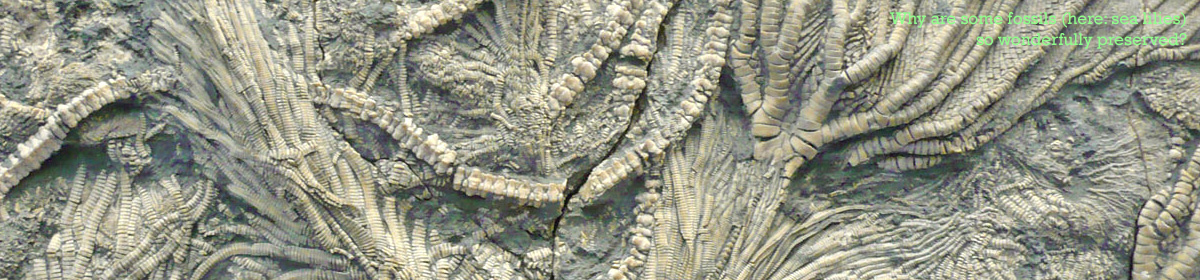
Recovery of marine communities
The first plants: colonising marshes
Insects and creepy crawlies
The first tetrapods
Dating rocks by fossils
- Rocks are ordered into a time-sequence by reference to fossils, using techniques that are logically robust. Nearly all fossil species are restricted to a very brief time-stratigraphic interval, and the commonly occurring ones can therefore serve to define such intervals.
- The most useful species for dating purposes are those which evolved rapidly, had a wide distribution and were easily preserved. They represent steps along an evolutionary lineage, their immediate forbears/descendants being sufficiently different in form to rank as different species. We know that they are separated in time, because if species A is above species B in one area, it will also be above species B in another area.
- As one goes up the taxonomic scale to genera, families and so on, the intervals become wider, but they are still well-defined. Fossils used for dating are typical of what is universally true of the fossil record: in the course of recolonisation and ecological recovery organisms were constantly diversifying, and in many instances it is possible to trace a substantial part of their phylogeny (family tree).
The status of the Genesis account
- Although distorted and often dismembered, many of the elements that make up the narrative of Genesis 1-3 and 6-9 occur in Sumerian and Akkadian texts of the third millennium BC, showing that these Genesis stories were once part of a common oral tradition that predated the earliest writing.
- Genesis therefore has a special status as documenting what may have been an oral tradition going back all the way to the antediluvian world, i.e. to the times it purports to describe.
- In scholarly inquiry the Genesis tradition should be treated like any other ancient text, as a document with a natural provenance, capable of being interrogated and requiring interpretation.
- Conversely, since Genesis may constitute an accurate record of a primeval tradition, it is unwise, a priori, to exclude it from research into origins. Potentially, the historical tradition about how the world began and scientific research into it can complement and shed light on each other.
Genesis 6-11 and other texts
The primeval tradition of all mankind
Radioisotope decay
- Methods of assigning absolute dates to strata depend on rates of radioactive decay, which now suggest that the Earth is billions of years old. Again, the techniques are sound, and the sequence of dates so obtained agrees with the results of biostratigraphic dating (the sequential ordering of rocks by fossils).
- Whether dates measured in millions of years correspond to reality depends on whether rates of radioactive decay have been constant over time, an assumption the primary evidence frequently throws into doubt. Examples of such evidence are discussed at:
- Radioactivity is the decay of certain unstable elements into other elements. Unstable elements, some of which were extremely short-lived, formed early on as a result of thermonuclear fusion/fission deep in the Earth’s interior. They are an example of how the whole creation (not just plants and animals) is not intended to be permanent but is in ‘bondage to decay’.
- Because radioactive decay can be inferred to have been much faster in the past, and heat is released proportionally, radioactivity is crucial to understanding Earth history. It is what drives nearly all geological change. Thus it is a vital part of the recolonisation story.
Events in real time
New land in the Archaean
How old is the Earth?
Tales of Cambrian jellyfish
Fast-accumulating tidal beds
Plate tectonics

- Plate tectonics is the driving force behind most geological processes, and in the past those processes were more rapid because plate-tectonic movements were more rapid.
- Plate tectonics is driven by radiogenic heat in the mantle. Not only were radioactive elements more abundant in the past (necessarily), but radioactive decay was more rapid. Consequently the heat generated by decay was much greater than that generated today.
- In geological terms the Earth’s ocean floors are young, no regions being older than Jurassic. They formed gradually as new floor spread out from mid-ocean ridges and old floor was cycled back into the mantle. Because rates of spreading were faster, marine temperatures were warmer, ocean floors more buoyant and sea levels higher.
- It is usually assumed that plate tectonics can also account for the generation of continental crust (the ‘island arc’ theory). However, the rate at which continental crust increased tailed off after the Proterozoic, in contrast to the rate of oceanic crust generation, and it is likely that in the Archaean continental crust formed predominantly by other processes.
- As a result of plate tectonics the face of the planet has changed dramatically over time, with consequent changes in climate and environment. Plants and animals after the cataclysm colonised a world that was continually evolving. In order to adapt to these changes, they themselves had to evolve.
The speed of light
- Astronomical distances are measured in terms of light years. Galaxies are typically hundreds of thousands of light years across and from tens to billions of light years distant from the Earth. Jets of plasma ejected from galactic nuclei can extend over hundreds of thousands of light years. If the Genesis account of creation is true, stars are not billions of years old and the light emitted from them did not take billions of years to reach the Earth.
- The implication is that the speed of light (‘c’) was once much faster than it is now.
- If c represents the maximum speed limit of all motion in the universe, and c was once much faster, then the maximum speed limit would have been higher in the past.
- Rates of radioactive decay are proportional to c. Accordingly, these rates would also have been higher.
- The value of c was highest at the time of the Creation. It had declined to close to its present value by the second millennium BC.
The limits of creation
- It is implicit in the concept of creation that God exercised his supernatural power to create only that which nature itself could not have brought into being. Conversely, whatever could have evolved of itself, did evolve of itself.
- Once created, nature was self-existent and operated according to the laws which God had established for it. This is not to rule out “miracles”, interventions that demonstrate his supernatural power, but it does rule out the idea that he ever subsequently intervened in order to achieve what he could not otherwise have achieved. When God said, “I will greatly multiply your pain in childbearing” (Gen 3:16), or “I will bring a cataclysm of waters upon the earth” (Gen 6:17), we should presume that he brought about these things through natural causes. The possibility that something happened naturally is not in any way incompatible with the idea that, as first cause, God willed and brought it about.
Life
 Life is fundamentally a mystery. Attempts to ‘explain’ life seek to nullify the mystery, but first define life as something other than what it really is.
- Life is that which animates, consciousness, endowing the organism with the capacity of voluntary action. Plants are not living organisms, but animals are, they have a ‘soul’ (Latin: anima). Genesis and other Hebrew texts describe the soul as the ‘breath of life’ (Gen 2:7, 7:15 etc).
- The soul is immaterial and therefore cannot be understood in terms of science, which by definition investigates only material things.
- The soul is not something that passes materially from generation to generation, evolving as it does so, and is not therefore amenable to a Darwinian explanation. It comes directly from God. The coming-into-being of every individual animal involves a fresh act of creation. Just how the soul becomes part of the growing organism is a mystery.
- In human beings the soul is the sense of self, and it is what enables us, in conjunction with our brains, to think. It enables us to perceive truth, and to solve problems on the basis of what seems true. If rational thought were reducible to the properties of atoms, properties such as truth and falsehood would be meaningless.
- The theory of evolution attempts to explain life in terms of non-life. However, in denying that rationality is something distinct from the laws which determine the behaviour of atoms, it is self-contradictory. A theory which holds that all products of the human brain, including sensations of rationality, are reducible to physical laws cannot itself have rationality.
Evolution – beware!
- The number-one fallacy or rhetorical device (depending on whether the confusion is unwitting or deliberate) of those who promote “evolution” as a matter of faith is that speak of “evolution” as meaning both biological change and descent from a common ancestor. These are different concepts that cannot be indiscriminately lumped together. As sciences, biology and palaeontology can bear witness only to biological change. This can be directional or random, there are examples of both, but what is not evidenced is change from simple to complex along branches of a single genealogical tree. “Evolution” is not the same as the theory of evolution.
- Thus the fact that organisms have changed over time tells us nothing about their ultimate origin: creation and evolution are not mutually exclusive concepts. Indeed, they belong together. We know that the form of a species is controlled by its genetic (DNA) program, and we know that the development of an individual through time is controlled by its genetic program. It is therefore a reasonable presumption that the evolution of a species through time is controlled by its genetic program.
- Indeed, any belief in creation that is informed by what God has revealed about himself in Scripture must integrate evolution into its concepts of natural history. Evolution is about adaptation and diversification, adaptation to the changing environments of a changing world and diversification as organisms populate the diverse niches of an initially unpopulated world. Since he is the Alpha and Omega, is outside time and knows the end from the beginning, God cannot plausibly be conceived as creating fixed species, incapable of colonising new environments or of adapting to changing ones.
Basic types, not species
- Major groups of plant and animal appear suddenly in the fossil record. Thus it is an empirically well-founded proposition that large-scale evolution, which certainly occurred in the course of Earth history, took place within the bounds of pre-existing organisms (e.g. within the bounds of distinct kinds such as archosaur, insect, bird, brachiopod).
- We may infer that in the beginning there were only a relatively small number of basic types, or kinds, but they had an inbuilt ability to evolve over time. This could also have been inferred in Darwin’s day. However, as Darwin pointed out, the fossil record was then far from adequately known. Another handicap was that nothing was known about the periods now known as the Hadean, Archaean and Proterozoic. Without some knowledge of them it would have been difficult to argue that fossils recorded the recovery of life from a global cataclysm. The requisite knowledge has been acquired only in the last 40 years.
- Similarly, while the structure of DNA was discovered in 1953, it is only now that we are discovering how fantastically complex the genetic code is, and how it might have been possible for the Creator to programme organisms with an inbuilt ability to evolve over time.
The limits of relatedness
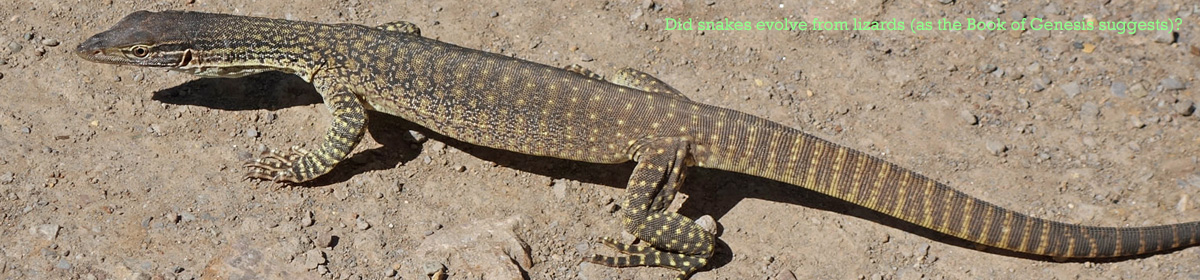
From land reptile to marine
Evolution can be rapid
- Rates of evolutionary change in the recent past tend to be much greater than in the radioisotope-dated fossil record. Evolution does not require millions of years.
- On the other hand, speciation ‘events’ in the fossil record tend to be sudden (giving rise to the theory of ‘punctuated equilibrium’).
- In many instances, the the change can be very substantial (e.g., the evolution of whales and dolphins from an ancestral land animal). The question is not whether such change occurred but how it occurred. Darwinism holds that it occurred by chance and predicts that phylogenies will testify to ‘numerous, successive, slight modifications’. Recolonisation theory holds that evolutionary pathways were genetically programmed from the outset and, because of the implausibility of complex biological systems coming together by a series of slight modifications, predicts that novelties not intrinsic to the initial body plan (e.g. eyes in a jellyfish) arose abruptly.
- In rare instances, evolutionary change may involve the transformation of one complex biological system into another (e.g. an ear suited to hearing in air to one suited to hearing in water).
- Since complex biological systems cannot be conceived as arising by a series of slight modifications, recolonisation theory predicts that major discontinuities between ancestral and descendant forms will be most common early in the evolutionary history of a kind. Diversification by smaller speciation events will be more common later in its history.
Metabolism
- This website traces the story of how the world was recolonised by marine, plant and animal organisms to the end of the Palaeozoic. At that point the living world suffered a second great crisis, marking the division between the Palaeozoic and the Mesozoic.
- The Mesozoic, dominated on land by the dinosaurs and in the sea by ichthyosaurs and plesiosaurs, represents a second great cycle of colonisation and as such requires separate treatment, as does the third great cycle of colonisation in the Cenozoic.
- Looking at the entire fossil record, it is possible to discern a succession where the terrestrial world is dominated first by amphibians and reptiles, then by mammal-like reptiles, then dinosaurs, then mammals and birds. Accordingly, Darwinism proposes that mammals evolved from mammal-like reptiles, and birds from dinosaurs. The evidence for such evolution is weak. An alternative approach is to see the succession as reflecting the importance of metabolism at different stages of Earth history. In the predominantly hot, damp climates of the Palaeozoic, cold-blooded animals thrived. In the warm, drier climates of the Mesozoic, it was animals with an intermediate metabolism that thrived. Mesozoic mammals appear to have been mostly nocturnal creatures. In the colder, more diverse climates of the Cenozoic, it was generally warm-blooded animals that thrived.
- Mammals, especially the larger ones, came into their own only as the world approached the conditions of the present day: a comparatively cool Earth, with high temperature gradients of latitude and season. Being able to generate their own heat internally, mammals can cope with temperature extremes better than other kinds.
- Much the same was true in the sea and the air. The warm shallow seas of the Mesozoic were dominated by marine reptiles. Even flying animals were predominantly reptile-like (pterosaurs), intermediate between the reptile and bird condition. Marine mammals came into their own only as the seas cooled, in the Cenozoic.
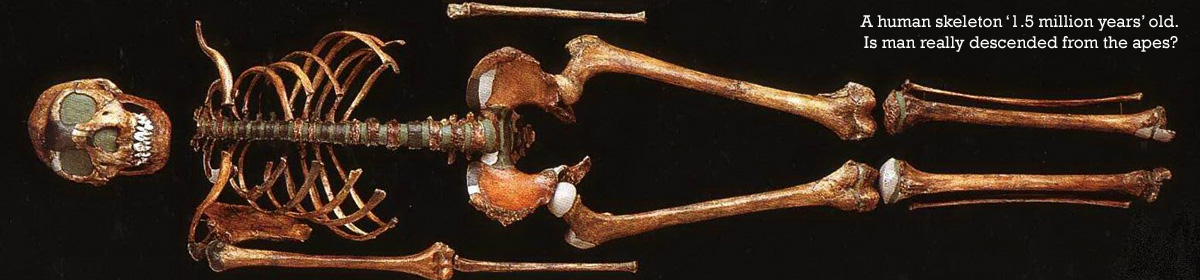
The late appearance of man
- The earliest human fossils date to the early Pliocene. Until then, man had not ventured beyond what is now Africa, geologically the most stable of the continents and therefore the safest place to be.
- Man appears late in the fossil record because, whether living as a farmer or as a hunter-gatherer in the forest, he had no reason to move, and he did not inhabit the places where natural disasters might have taken him unawares so as to leave traces of his existence.
- Also, it tends to be assumed that ever since the Creation God and man have lived in different realms. This is not quite the picture Genesis presents: whereas man was expelled from the garden of Eden, God remained. In the postdiluvian world God may have continued to dwell in the midst of his creation. As when the Israelites had to survive in the wilderness,
- Man stayed in one place, in his Creator’s presence, though that one place will have shifted over time. Egyptians called the place “God’s Land” and located it in Cush, or modern Ethiopia. At length, towards the end of geological history, when the Earth was close to its present state and safe enough to be colonised, God departed, leaving man to explore the other continents in migrations which Genesis partially reflects in its ‘table of nations’.
- The confusion of language at Babel was a real event, datable to c.3150 BC (tree-ring-calibrated radiocarbon time). More than 90% of today’s languages can be traced back to 17 ancestral languages from about that time. The biblical Nimrod can be identified with the Sumerian priest-king Enmerkar, who instigated a theological revolution in which Ea, god of heaven, was eclipsed by Inana, a king-making fertility goddess.
he shielded him, he cared for him,
he guarded him as the apple of his eye.
he guarded him as the apple of his eye.
- In the second millennium BC, by which time the Near East was divided into nations, God returned, choosing Israel as the nation amongst whom he would dwell. But they broke their marriage covenant with him. Just before Jerusalem’s destruction by the Babylonians, he abandoned his house, but promised to return (Zech 8:3), which he did six centuries later. The Creator manifested himself in human flesh, his body now replacing the house in Jerusalem. That too was destroyed, on a cross. But he rose from the tomb in which he was laid and before ascending into heaven promised that he would once more return, this time to dwell forever with all mankind. In the interim, anyone who put their trust in him would receive his spirit and become a member of a new holy nation. They themselves would be his body, his dwelling-place.
- He is therefore still present in the world, still witnessing to it concerning sin and righteousness and judgement. One day soon he will come back, the bridegroom with his bride, and he will rule the nations until the whole earth is brought under his governance.